
How to create an AI film where the heroine maintains her face and clothing, the camera moves through the same space, and the crowd performs a planned movement? This guide takes you from the script and reference materials to the first generation, corrections, and export. It includes ready prompts and a training scene with a megaphone.
Documentation verification: October 6, 2026. The interface, model availability, and costs may change.
The starting point is the description of the STORM parody by @kiselevajuli. The author shows a film with three main characters, a crowd in school bleachers, and a moving camera. Below, we discuss the method, and the exercise, prompts, and illustration are our examples. We do not share her source materials or the original music video.
- Image generator for character, location, and prop cards.
- Higgsfield with access to the appropriate video model; check availability on your own account.
- A short script, established film proportions, and a trial budget.
- Optionally, your own motion clip and recording of the heroine's lines.
First, the Scene on Paper
In the exercise, an adult leader approaches eight adult dancers in the bleachers. She raises a red megaphone, says, “Once more, from the beginning,” and the group performs a joint bow and rise. The entire sequence lasts 15 seconds. Choose 16:9 if you want to clearly show the group; for a vertical film, plan a tighter arrangement of people.
Record the starting positions: the leader two meters in front of the lowest bench, the group in two rows, the camera behind her right shoulder. Also define the end: the camera has pulled back to the square, the leader stands by the bench, the megaphone at her right hip. This creates continuity control points.
Heroine Card: Face and Clothing in One Image
The card should separately show the face and the outfit structure. In the STORM method, a large portrait occupies a significant part of the image, alongside front and back views of the silhouette. The author crops the front at collar height to limit competition between the small face and the large portrait. This is her practical tip, not a mandatory model format.
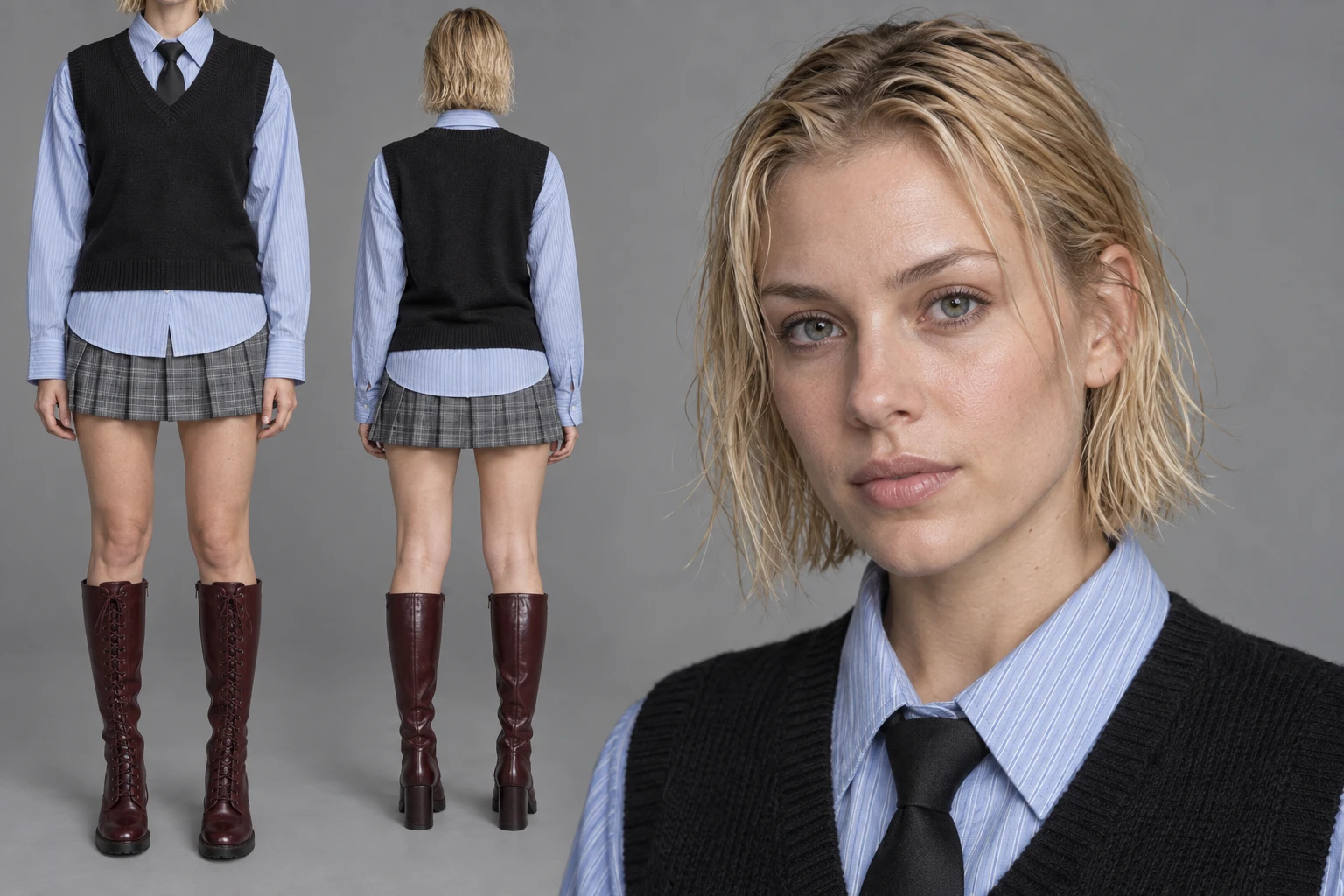
You can open the card in full size and save it as a reference. This is a fictional person, not a photo of the STORM author. More about preparing views can be found in the character card guide.
Create a photorealistic character reference sheet of one fictional adult woman, age 28. Blonde wet-look bob, natural skin texture, neutral expression.
Flat neutral grey studio background, even lighting. Right side: a large three-quarter head-and-shoulders portrait with small catchlights in both eyes. Left side: a front body view cropped exactly at the collar, and a full-body rear view with boots visible.
Identical outfit in every view: light-blue striped oversized shirt, black knitted V-neck vest, black tie, grey plaid pleated skirt, burgundy lace-up knee-high boots. Relaxed standing posture. Plain background, no lettering or props.
If you are working with your own photos, attach them and replace the first sentence with: Use the attached photos as the identity reference. Preserve the same facial features, skin tone and body proportions. Review each view before approval: hair length, vest cut, tie, skirt pattern, and shoes. The reference material should be clear; grain, contrast, and film color can be added to the video scene.
Two Supporting Characters
In STORM, characters have a common uniform but different hairstyles. In your own project, assign each one a clearly visible feature and a consistent name. Example: TALKER – dark, very short hair; SITTER – long light brown bangs. Separate references and names help unambiguously assign actions.
Build the Space Through Which the Camera Will Move
Prepare the main view of the location, a view in the opposite direction, and one or two angled overhead views. In the STORM description, these images are meant to maintain the layout of the school, square, and bleachers during perspective changes. Keep the direction of sunlight, materials, number of steps, and railing placement.
Photorealistic empty rehearsal location: a red-brick community arts building behind five wide black wooden bleacher benches. Stone-paved plaza in front, a metal railing on the right, lawn and trees beyond the plaza. Three-quarter view from the plaza, all five benches visible. Soft late-afternoon sunlight from camera left, shadows falling toward the right. Natural architectural proportions, no people, no lettering.
Use the attached image as the location reference. Preserve the same building, five black wooden bleacher benches, stone paving and right-side metal railing.
Show the view from the top bench looking back across the plaza toward the lawn and trees. Include the top bench edge in the foreground. Preserve the time of day and the world-space direction of sunlight and shadows. Empty location, photorealistic perspective.
View the images side by side. A new angle where the railing has disappeared or the number of benches has changed requires correction. In the script, use anchor points: “by the right railing” and “on the lowest bench,” instead of just “in the courtyard.”
Props, Movement, and Voice
Recognizable Object
Prepare a significant prop separately, against a simple background. In our exercise, this is a megaphone; in the STORM realization – a gun. In the action description, also specify the hand and the moment of setting down the object.
Product reference photograph of one red handheld megaphone with a black handle and black rim. Side view on a seamless white background, soft even studio lighting, sharp object detail and a subtle contact shadow. Entire object visible, unbranded, no hands or lettering.
Movement from the Clip
The STORM author describes good results with a full choreography reference, without additional cropping. This does not mean that every input film must remain untouched. In the exercise, record your own clear trial: eight adults in two rows bowing, returning to upright, and repeating the movement. The camera can remain stationary.
Assign a narrow task to the clip: it provides the group's movement. Camera movement and story pacing are described separately. Such separation is the intent of the prompt; the model may require several attempts.
Recording Lines
Record “Once more, from the beginning” at a natural pace, with a short pause before and after the sentence. For several lines, maintain the order of the script. Do not assume that the audio file will automatically ensure perfect synchronization – watch the lips and check the moment the speech begins.
File Map: What Corresponds to What
The sample labels below are an agreement of this guide. After uploading materials, check the actual labels in the interface and correct them in the prompt. Do not assign one number to two different materials.
| Reference | Exercise File | Task |
|---|---|---|
| @Image1 | Heroine Card | Face, hairstyle, outfit |
| @Image2 | Front of Location | Bleachers and building |
| @Image3 | Opposite Angle | Layout of the square and greenery |
| @Image4 | Megaphone | Shape and color of the object |
| @Video1 | Your Group Trial | Choreography |
| @Audio1 | Recording of Lines | Voice and speech |
Direct Continuous Action
Each time segment starts where the previous one ended. The next person should already be visible before the camera approaches them. Describe the physical path of the operator, not just a list of subsequent shots.
| General Description | Instruction to Execute |
|---|---|
| The camera shows the crowd | The operator steps back three steps across the stone plaza, revealing both rows on the benches |
| The hero is terrified | The boy clenches his hands on his knees, swallows, and briefly looks up |
| Film camera | The camera follows the heroine's right shoulder; the operator's step causes slight swaying |
| Then another person | The second person is visible by the railing; the camera approaches them without changing the scene |
In STORM, the author recommends avoiding excess actions at one moment. A long prompt may be needed, but its length does not guarantee quality. In 15 seconds, do not try to fit three conversations, running through the crowd, and a complicated dance.
One continuous 15-second take in real time. Grounded cinematic realism, warm late-afternoon light, muted red brick, navy clothing and grey stone.
CAMERA: Handheld movement with subtle footstep bounce, small horizon shifts and natural reframing. The camera travels continuously through the described space. Maintain uninterrupted real-time action throughout.
REFERENCES: @Image1 is LEAD, the adult woman with a blonde bob, light-blue striped shirt, black knitted vest, black tie, grey plaid pleated skirt and burgundy boots. @Image2 provides the building and black wooden bleachers. @Image3 provides the reverse view of the same location for spatial continuity. @Image4 is the red megaphone. @Video1 provides only the group choreography; camera movement and story timing follow the written directions. @Audio1 provides LEAD's voice and exact spoken line.
GROUP: Eight adults in worn navy blazers, white shirts and loose navy ties, standing in two rows on the lowest bleacher benches.
0–4 seconds: The camera follows LEAD, @Image1, from slightly behind her right shoulder as she walks toward the lowest bench. She carries the red megaphone, @Image4, in her right hand. Both rows of the group are already visible ahead, quietly talking among themselves. She stops on the paving beside the right end of the lowest bench.
4–8 seconds: From the same position, LEAD turns toward the group. The camera walks around her left side, keeping her and the group visible. She raises the megaphone to her mouth with her right hand. LEAD, using @Audio1, says: "Jeszcze raz, od początku." Conversations stop. One dancer straightens their tie; another shifts their weight and looks at her.
8–12 seconds: LEAD lowers the megaphone to her right hip. The camera backs away across the stone paving, gradually revealing both rows. The group begins the synchronized movement from @Video1: they fold forward, then rise together. LEAD stays upright beside the lowest bench, watching them.
12–15 seconds: The camera continues backing away from the same angle. The dancers finish the next movement together and return to standing. LEAD gives a small approving nod. The megaphone remains in her right hand against her right hip.
SOUND: Footsteps on stone, brief quiet conversations at the beginning, LEAD's amplified Polish line, shoes on wooden benches, moving clothing and soft outdoor ambience.
Don't have a clip or audio? Remove the reference to the missing file. Replace the movement with the description “the group slowly bends forward and returns upright together.” For the voice, write “LEAD speaks Polish in a clear adult female voice.” This is a variant with movement description and generated voice, not a playback of the reference.
How to Plan a Longer 30-Second Shot
A full STORM example is available from the author. The plan below shows the function of its segments, without copying dialogues. It serves to understand how the camera connects characters and actions.
| Time in STORM | Function of the Segment | What to Check on Your End |
|---|---|---|
| 0–4 s | Chaos and reaction of the main heroine | Is the place and crowd movement visible from the start? |
| 4–11 s | Transition to the seated character and her speech | Does the camera have a clear path, and is there time for dialogue? |
| 11–19 s | Confrontation in motion | Do hands, positions, and props maintain continuity? |
| 19–24 s | Setting the group for the finale | Do all reach their places? |
| 24–30 s | Choreography and camera pullback | Does the heroine remain recognizable in the wide shot? |
First Generation and Version Selection
Official Higgsfield help indicates entry through Video and handling images, clips, and audio. Seedance 2.5 allows generating from 4 to 30 seconds. Reference-to-Video documentation lists resolutions of 480p, 720p, and 1080p.
- Select Model and Format
Open Video, select Seedance 2.5, set 15 seconds and 16:9 for our exercise. If the option is not available on your account, check access to the model before purchasing a plan.
- Upload References
Add the card, location, prop, and your own clip and audio if you are using them. Compare labels with the map in the prompt.
- Check Trial Cost
The STORM author works at 480p; official help recommends short trials at 720p for beginners. Choose an available working resolution and check the cost shown before generation. We do not provide a fixed price as it depends on settings and plans.
- Evaluate the Entire Film
Check the first, middle, and last second, as well as each lift of the prop and moment of dialogue. Note one major error.
- Change One Element
Correct the camera description, one action, or reference. Keep the previous file and prompt to compare the result.
Diagnostics of Common Problems
| Symptom | First Fix to Test |
|---|---|
| Different face in the middle of the film | Check the card; repeat the character's label and hairstyle and clothing during significant actions |
| Wardrobe changes | Unify the views of the card; remove conflicting outfit descriptions |
| Location changes after a turn | Add the opposite angle and specific camera path; check the geometry of references |
| Editing cut appears | Connect the end and beginning of adjacent segments; show the next character earlier |
| Megaphone switches to the other hand | Repeat “right hand” when lifting and lowering; simplify the gesture |
| Dialogue cuts off | Shorten the speech or give it more time; listen to the audio file |
| Crowd performs chaotic movement | Simplify the choreography and use a clear frontal clip of your own trial |
| Camera moves too smoothly | Describe slight footstep bounce and natural frame corrections, without adding many effects |
Upscale, Editing, and Next Shots
When a specific version is successful, save it and upscale this file with an available tool. Regenerating with the same prompt and higher resolution creates a new variant. This difference is an important element of the STORM method: do not risk losing good acting just because you need a larger image.
Divide a longer story into shots. For each, record the final camera and character settings, the hand with the object, light, and sound. The last frame can be a reference point for the next shot if the chosen mode supports such input. Edit only after checking continuity.
Rights to Materials and Privacy
Practice on a fictional character, your own photos, your own choreography, and your own voice. Before using materials from others, determine whether you have permission or the appropriate license, especially for commercial publication. Do not assume that using a recording as a reference removes the issue of rights. Label AI examples so that the recipient does not confuse them with documentation of a real event.
Questions Before the Next Trial
Do I need to write the prompt in English?
Examples are in English for easy transfer to the generator. We do not treat this as a requirement. The dialogue remains Polish; listen to the result and assess the pronunciation.
Will an identical prompt yield an identical film?
Do not base your work plan on such a guarantee. Keep accepted files and version numbers, instead of trying to recreate them later with just text.
Do we have a finished film for this example?
No. The published card is a ready reference image; the script and prompts are an exercise to be completed. We do not claim that this scene was generated and tested as a film.
Do I need all references?
You can start with the card and one view of the location. Limit the camera movement and the number of actions then. Remove references to files you will not upload from the prompt.
What is Confirmed and What Requires Trials
- Documentation: image, video, and audio inputs, generation up to 30 seconds, and listed resolutions are described by Higgsfield.
- Author's Account: layout of cards, additional angles of locations, full dance clip, and 480p iterations are solutions from her STORM realization.
- Our Exercise: the scene with the megaphone, shorter script, and prompts for its materials are an original proposal.
- No Guarantees: ideal identity, choreography synchronization, absence of cuts, and the number of required trials depend on the result of a specific generation.
Checklist Before Exporting
- The face, hairstyle, and outfit remain consistent with the card.
- The location does not change geometry with camera movement.
- The object remains in the specified hand.
- The dialogue is complete and spoken by the correct person.
- The planned actions have been executed, and the final position is clear.
- The final film, references, and prompt used for its generation have been saved.
Sources and Further Learning
- @kiselevajuli – description of the STORM parody construction: creative experience, not product specification; the page contains affiliate links.
- Higgsfield – How do I use Seedance?: official help regarding models and references.
- Seedance 2.5 Reference-to-Video – API reference: official description of parameters.
- Focal Points in AI Films: selecting perspective for the scene.
Comments (0)
No comments yet. Be the first!