
In 1970, 55 people finished a marathon held exclusively in Central Park. On Sunday, November 1, 2026, nearly 60,000 participants faced a completely different challenge: 42.195 km through five boroughs of New York City, five bridges, and streets filled with spectators.
This year's men's competition was won by Swede Andreas Almgren, who was making his marathon debut. Among women, the best was Kenyan Sheila Chepkirui. In the wheelchair division, the winners were Swiss Marcel Hug and Catherine Debrunner. But the history of the New York race is not limited to winning times: it includes a sit-in protest by six female athletes, a wrong turn just before the finish line, and a Polish runner who won by five seconds.
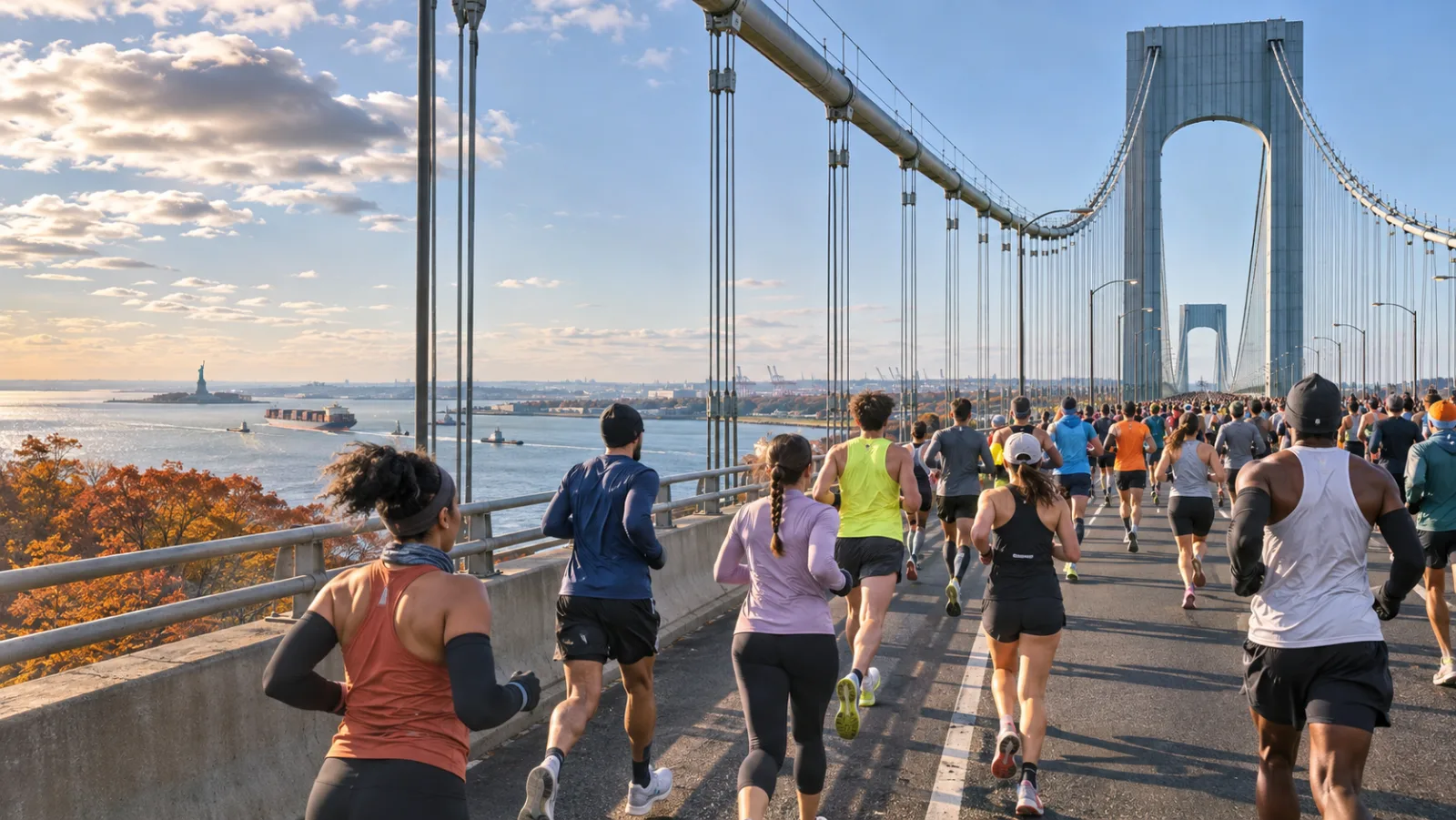
- The last marathon took place on November 1, 2026. Almgren achieved 2:06:01, and Chepkirui 2:24:36.
- In the wheelchair division, Marcel Hug won with 1:28:14, and Catherine Debrunner with 1:40:02.
- The first race in 1970 took place in Central Park. The route through five boroughs appeared in 1976.
- Wanda Panfil won the women's competition in 1990, achieving 2:30:45.
- The route starts on Staten Island, goes through Brooklyn, Queens, and the Bronx, and finishes in Central Park in Manhattan.
In this guide:
Who won the New York Marathon on Sunday, November 1, 2026
In the Sunday TCS New York City Marathon, the first to finish in the open men's category was Andreas Almgren from Sweden, and among women Sheila Chepkirui from Kenya. The wheelchair race was won by Marcel Hug and Catherine Debrunner from Switzerland. The following times are from the World Athletics report and the organizer's announcement. World Athletics: race report; NYRR: results and summary.
| Competition | Winner | Country | Time |
|---|---|---|---|
| Men, open | Andreas Almgren | Sweden | 2:06:01 |
| Women, open | Sheila Chepkirui | Kenya | 2:24:36 |
| Men in wheelchairs | Marcel Hug | Switzerland | 1:28:14 |
| Women in wheelchairs | Catherine Debrunner | Switzerland | 1:40:02 |
The organizer also maintains a classification for non-binary individuals and other categories. Their current results can be checked in the NYRR results search. We do not provide the name of the winning individual in the non-binary classification here, as we were unable to independently verify it at the time of writing this text.
Almgren's first marathon and Chepkirui's strong finish
Almgren had previously achieved success at shorter distances, but this was his first marathon in New York. In the final part of the race, he broke away from his rivals. Italian Yemaneberhan Crippa finished second in 2:06:14, and Kamohelo Mofolo from Lesotho third in 2:06:26. The latter celebrated his 21st birthday on race day. Italian Athletics Federation: top results.
In the women's race, Chepkirui, the winner from 2024, competed closely with Hellen Obiri, the champion of the previous edition. At the finish, American Jess McClain overtook Obiri and took second place in 2:24:42. Obiri was third, just a second behind her. The six-second difference between the first and second runners shows that even after more than two hours of running, the final meters can determine the podium.
Two Swiss victories in the wheelchair races
Marcel Hug won in New York for the eighth time. According to the organizer, he beat Daniel Romanchuk by a second. Catherine Debrunner won with a time of 1:40:02, building nearly eight and a half minutes of advantage over the second competitor, Tatyana McFadden.
These results pertain to a separate competition for racing wheelchairs, not a direct comparison with foot races. Racing wheelchairs, propulsion techniques, and the profile of the route affect the times differently than in running. Debrunner was already familiar with the New York route to victory: in her debut in 2023, she achieved 1:39:32. NYRR Media Guide, Debrunner profile and statistics.
NYRR reported on race day that there were nearly 60,000 participants. This is an approximate number provided by the organizer and should not be automatically equated with the final number of individuals who completed the race. Complete data may be updated in the official results database.
Route: 42.195 km through five boroughs
The New York Marathon is a tour through the city, but it does not start where many tourists first look for a map. The start is on Staten Island, at the Verrazzano-Narrows Bridge. From there, runners go through Brooklyn and Queens, briefly enter the Bronx, and return to Manhattan, where the finish line awaits in Central Park. The exact streets and organization of the start should be checked for the specific edition. NYRR: 2026 marathon route.
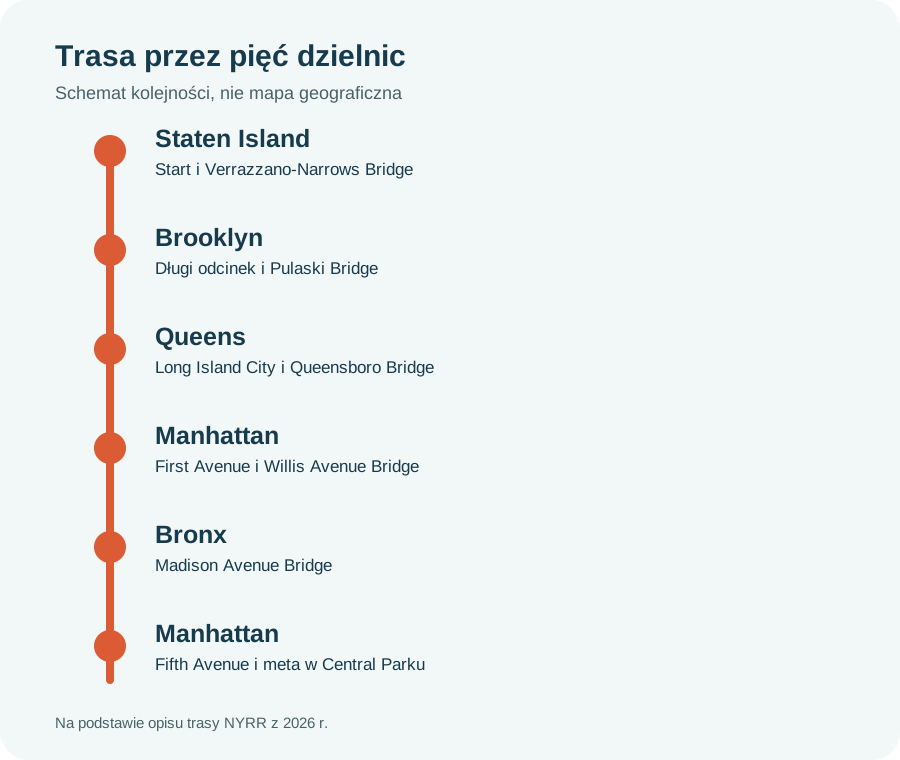
| Section | What happens along the way |
|---|---|
| Staten Island | Start and crossing the Verrazzano-Narrows Bridge towards Brooklyn. |
| Brooklyn | Long stretch through various neighborhoods; the route then heads towards Pulaski Bridge. |
| Queens | After crossing Pulaski Bridge, runners go through Long Island City and onto Queensboro Bridge. |
| Manhattan | After descending from Queensboro Bridge, the route leads along First Avenue to the north. |
| Bronx | Short section after crossing Willis Avenue Bridge; return via Madison Avenue Bridge. |
| Manhattan and Central Park | Fifth Avenue, Central Park, and finish in the park. |
Five bridges and a surprisingly short Bronx
Verrazzano-Narrows is a grand gateway to the route. The bridge has two levels, and the organization of the start divides participants into waves and groups. On the wide crossing, it is easy to feel the excitement of the beginning, but it is also easy to start too quickly. The elevation of the bridge and the first kilometers remind runners that a marathon is not about sprinting from the starting line.
Pulaski Bridge connects Brooklyn to Queens and is located around the halfway point. NYRR points out that the bridge itself is closed to spectators: those wanting to see the runners at this location can choose the Queens side, behind the crossing. NYRR: cheering locations.
Queensboro Bridge leads from Queens to Manhattan. After the section on the bridge, runners enter the area of First Avenue, known for its crowds of spectators. This is a change not only in scenery: it is quieter on the bridge, louder on the street. Not everyone hears the city in the same way, but the difference between the bridge and the crowded avenues often appears in stories about the race.
Willis Avenue Bridge leads to the Bronx. The section in this borough is relatively short, after which Madison Avenue Bridge directs participants back to Manhattan. By this time, runners are approaching the final part of the marathon, not the end of their effort: the route continues along Fifth Avenue and into Central Park.
What changed in the Bronx in 2026
On the 50th anniversary of the route through five boroughs, the organizer adjusted its section in the Bronx. After Willis Avenue Bridge, the route went through East 135th Street and Alexander Avenue, then turned onto East 141st Street, Third Avenue, and East 138th Street before Madison Avenue Bridge. NYRR explained the change as a need to limit the impact of the event on the area. According to the organizer, this was the first route change in 15 years. Description of the change and NYRR route.
Why is this interesting? We are talking about a short section of a long race, but closing streets affects transportation, residents, shops, and services. Even a seemingly minor correction requires reconciling the race with the life of the city. The diagram in this guide shows the order of boroughs, not a detailed plan of street closures.
How the marathon was created: Central Park and a one-dollar entry fee
The first edition was organized on September 13, 1970. The initiative was led by New York Road Runners activists, including Fred Lebow and Vince Chiappetta. The race took place in Central Park: instead of touring five boroughs, runners completed just over four laps of the park. NYRR reports a budget of about 1,000 dollars and an entry fee of one dollar. History of New York Road Runners.
According to the marathon's history on the NYRR website, 127 people were registered, and 55 reached the finish line. The organizer's media guide also mentions a number of 126 participants. The organizer's sources are not entirely consistent here, so it is safest to say: about 127 registered and 55 finished. Do not confuse registered, starters, and finishers. NYRR marathon timeline.
Gary Muhrcke, a firefighter associated with New York, won. The only registered woman, Nina Kuscsik, did not finish the race due to illness. However, she returned to the New York course and won in 1972 and 1973. In 1971, Beth Bonner became the first woman to finish the New York Marathon. NYRR: history of women in running.
1976: the race goes out of the park
In 1976, the marathon was first taken to the streets of all five boroughs. The event was linked to the celebrations of the 200th anniversary of the United States. NYRR reports 2,090 registered and 1,549 who finished this edition. Bill Rodgers and Miki Gorman won their respective competitions. Rodgers would later win in New York four times in a row, from 1976 to 1979.
The change was more than just an extension of the list of streets. The race, which took place in one park, became a shared event for the city: the start and finish were far apart, requiring cooperation from many services, and the boroughs became part of the sporting spectacle. In 2026, it was 50 years since the first race on the five borough route. This is an anniversary of the route, not the 50th edition of the entire marathon.
Six women sat at the start
In 1972, six female athletes registered for the New York Marathon, but they were subject to a separate start rule that prevented women from competing alongside men. When the race began, they sat at the starting line for ten minutes, protesting against unequal treatment. Only then did they start the race. NYRR: the story of Lynn Blackstone and the protest.
Among the protesters were Lynn Blackstone, Jane Muhrcke, Liz Franceschini, Pat Barrett, Nina Kuscsik, and Cathy Miller. NYRR describes them as “Six Who Sat.” This small group stands out against today’s crowd, but their action became a symbol of the fight for equal space for women in street racing. The organizer points out that the protest contributed to a change in the rules. NYRR Media Guide: The Six Who Sat.
Grete Waitz and nine victories
Norwegian Grete Waitz came to New York in 1978 for her first marathon. She won and set the then world record of 2:32:30. The following year, she achieved 2:27:33, going below two and a half hours. In total, she won in New York nine times, the last time in 1988. NYRR Hall of Fame: Grete Waitz.
In 1992, Waitz did not compete in New York for another title. She accompanied Fred Lebow, who ran the marathon after treatment for brain cancer. They completed the course together in 5:32:34. For the athlete known for winning, this was a different kind of race: the pace was set by a shared goal of reaching the finish line.
Wanda Panfil: Polish victory in 1990
On November 4, 1990, Wanda Panfil won the New York Marathon with a time of 2:30:45. Second place Kim Jones crossed the finish line five seconds later. For Polish fans, this is one of the most significant moments in the history of Polish runners' participation in the New York event. NYRR Media Guide: results and description of the 1990 edition.
This same race had another context: after two years of health issues, Grete Waitz was trying for her tenth victory. She finished fourth. Panfil thus won in a competition where she encountered the history of the multiple New York champion and a new Polish triumph. A five-second lead after more than 42 kilometers is also a reminder of how long the fight for victory can last.
Pulaski Bridge on the route is named after Kazimierz Pułaski, a Polish-born participant in the fight for the independence of the United States. It is not a monument to Panfil nor an element named in honor of her victory; the name of the bridge and the athlete's result are two separate Polish curiosities along the marathon route. New York State Department of Transportation: Pulaski Bridge.
Ryszard Marczak and Kamila Gradus: just off the podium
Polish participation in New York does not end with Wanda Panfil's victory. Ryszard Marczak finished fifth in 1981, and the following year he took fourth place with a time of 2:12:44. The Polish Athletics Association reports that he has finished the marathon there multiple times and has also won veteran classifications. The fourth place from 1982 is confirmed by the NYRR archive. PZLA: Polish performances in New York; NYRR: results 1982.
In 1992, Kamila Gradus finished fourth among women with a result of 2:30:09. In the same edition, Antoni Niemczak was fifth in the men's competition. These are historical results from specific editions, not a classification of all Polish participants in the marathon. PZLA: Polish placements in archival editions.
Panfil had exceptionally successful two seasons: according to PZLA, in 1990 she won marathons in Nagoya, London, and New York, and in 1991 she triumphed in Boston and at the World Championships in Tokyo. This provides a broader context for her New York victory, rather than five triumphs in one city. PZLA: Wanda Panfil's achievements; Polish Olympic Committee: athlete profile.
Stories That Are Easy to Overlook
Won Despite Taking a Wrong Turn
In 1994, Mexican runner Germán Silva was battling for the lead with fellow countryman Benjamín Paredes. About half a mile from the finish, Silva took a wrong turn in Central Park. When he realized his mistake, he returned to the course, made up the lost ground, and passed his rival. He won by two seconds. The following year, he won again. NYRR Hall of Fame: Germán Silva.
This story does not imply that making a mistake on the course is a good idea or that every runner could recover in the same situation. It is remarkable precisely because it happened so close to the finish, during a direct battle for victory.
A Bridge Where Runners Needed a Carpet
The NYRR media guide describes an unusual detail from the late 1970s. Organizers covered the surface of the Queensboro Bridge with carpeting; in the first five-borough race in 1976, third-place finisher Chris Stewart completed the race with bloodied feet. This serves as a reminder that a major road race also involves very practical issues: what surface will thousands of people safely run on? NYRR: archival descriptions of marathon editions.
2001, 2012, and 2020: The City and the Race in Difficult Years
The marathon in 2001 took place less than two months after the September 11 attacks. Organizers described it as an event associated with hope and the rebuilding of the city. In 2012, the race was canceled due to Hurricane Sandy; some runners participated in relief efforts after the disaster. In 2020, during the COVID-19 pandemic, the edition was virtual rather than a traditional race through the closed streets of the city. NYRR: timeline of cancellations and virtual editions.
Therefore, the calendar year, edition number, and anniversary of the five-borough course are not the same. When someone speaks of the "50th anniversary" in 2026, it is worth checking whether it refers to the five boroughs since 1976, rather than the date of the first race in 1970.
2025: Record and Race Decided by a Fraction of a Second
The year before this year's race, Hellen Obiri set the women's course record in New York: 2:19:51. In the men's competition, Benson Kipruto defeated Alexander Mutiso by a fraction of a second. In results published to the nearest whole second, a small difference is not always immediately visible, which is why the order is determined by official timing. World Athletics: report from 2025; Associated Press: men's finish.
The official NYRR results page lists 59,219 finishers for 2025. This data pertains to completed races from that edition. It should not be presented as the final number of people who completed the marathon in 2026. NYRR: summary of 2025 results.
Marathon Record and World Record Are Different Numbers
A course record means the fastest time achieved in a given competition at the New York marathon. A world record is a separate category, dependent on ratification rules, measurement, and other requirements. One should not assume that one course is easier based solely on time differences: factors such as wind, elevation, weather, tactics, and the flow of competition are significant.
Bridges, changing street profiles, and late elevations make New York often described as a marathon requiring sensible energy management. A runner can win the race without setting a course record, and an amateur participant can achieve a personal goal long after the leaders have crossed the finish line.
When the Course Turned Out to Be Too Short
The results of the 1981 marathon were then presented as record-breaking. However, a later re-measurement revealed that the course was approximately 150 meters short. NYRR explains that the race was considered correctly measured according to the standards accepted at the time of the edition, but after re-measurement, the assessment of record results changed. This is a good example of why a course record, historical record, and contemporary ratification are not always the same. NYRR: archival description of the 1981 edition.
Music Accompanying the Start
For many participants, the memory of the race's start is associated with "New York, New York" performed by Frank Sinatra. The NYRR coach describes the transition from music at the start to the roar of First Avenue after leaving the Queensboro Bridge. This is part of the atmosphere of the event, although the details of the presentation may change between editions. NYRR: coach's story about the course.
Gross and Net Time: Why Are There Two Different Numbers?
With wave starts, some people cross the starting line only after the signal for their group. Therefore, the time counted from the signal and the time counted from the individual's crossing of the line can differ. NYRR explains on the starting page that a participant's net time runs from the moment they cross the starting line. This helps to understand the result of someone who started far behind the leaders; classification and award rules should be checked for the specific category. NYRR: wave starts and net time.
How to Prepare for Your First Marathon
Health Before the Plan: The following tips are educational and are not individual medical advice or a training plan. If you have a chronic illness, symptoms during exertion, a recent injury, are pregnant, or are returning to activity after a long break, discuss preparations with a doctor or appropriate specialist. A person who is not currently running should first build a basic level of fitness; the period outlined below does not replace this stage.
How Much Time Is Needed and Where to Start
Ready marathon plans often last 16–24 weeks, but they are for individuals who already have some base. The Hospital for Special Surgery indicates that beginners may need at least six months of preparation. If you are just starting with walking, you may need more time. Simply marking the start date on the calendar does not make the plan suitable for the body. HSS: choosing a plan and gradually increasing loads.
An example 18-week NYRR plan is designed for someone who is already running an average of four or five days a week and whose longest run lasts about 40 minutes. This is not a "couch to marathon" plan. For a beginner, earlier learning of regular walk-run and building a habit may be a separate, longer stage. NYRR: example plan and its assumptions.
What Should Be Included in the Week
A typical plan for someone already running combines easy runs, one longer workout, rest, and strength exercises or other activities. Faster intervals or hill workouts may be part of the plan, but they are not mandatory for someone who is just getting used to regular running. The pace and frequency should be adjusted to experience, fatigue, and health status.
| Element | Purpose | What to Watch Out For |
|---|---|---|
| Easy run or walk-run | Builds regularity without the need to race in every workout. | Pace should allow for controlled effort; switch to walking if necessary. |
| Long run | Helps practice time on feet, pacing, and eating while moving. | Gradually increase distance and include time for recovery. |
| Strength and stabilization | Supports fitness needed for running and daily functioning. | Introduce new exercises gradually; do not add heavy training to already increasing pain. |
| Rest | Allows the body to recover after exertion. | A day without running can be part of the plan, not a failure. |
An example easy week does not have to look the same for everyone: after a rest day, there may be a short run, followed by strength exercises or rest, another easy run, a lighter day, and a longer workout on the weekend. These are not rigid days or recommendations for specific mileage. If you cannot return to normal activity after a long workout, discuss the load with a coach or physical therapist.
HSS points out that a sudden increase in weekly mileage was associated with a higher risk of injury among studied runners preparing for the New York marathon. However, there is no single magic percentage rule that guarantees safety for everyone. Monitor the total training, sleep, previous injuries, and how you feel the next day.
Long Runs: Do You Have to Run the Whole Marathon Before the Race?
No. NYRR emphasizes that there is no single mandatory length for the longest training run. In many plans for individuals with an appropriate base, runs of about 18–20 miles, or 29–32 km, appear, but this is not a threshold that every beginner should reach. The entire preparation period, individual tolerance for exertion, and recovery ability matter. NYRR: questions about long runs.
If a planned training session falls during illness, a storm, or dangerous heat, health is more important than checking off the distance. Do not automatically try to make up for missed miles the next day. Rescheduling, shortening, or skipping a workout may be a wiser choice.
Eating and Drinking: Practice Before Race Day
During long training, you can check which products and drinks your stomach tolerates and how to carry and consume them while moving. Check the carbohydrate content on the packaging, as gels vary in composition. In a conversation published by NYRR, a dietitian suggests approximately 30–60 g of carbohydrates per hour for endurance efforts lasting over an hour to about 2.5 hours; for longer efforts, needs may differ. This is a range for individual discussion and practice, not a mandate for every runner. NYRR: conversation about marathon nutrition.
In the example, a gel containing 25 g of carbohydrates and a drink containing another 10 g provide a total of 35 g. This is solely an example of calculation, not a prescription for the first hour of running. Factors such as gastrointestinal tolerance, duration of effort, weather, and individual needs are significant. Individuals with diabetes or other conditions affecting nutrition should discuss their plan with the medical team in advance.
Hydration also requires moderation. Needs vary between individuals and change with temperature and sweating. Both dehydration and excessive fluid intake can be dangerous; too much water can lead to hyponatremia, or low sodium levels in the blood. During prolonged exertion, electrolytes are also important. Do not assume that more water or salt tablets always means a safer run. NYRR: heat, dehydration, and overhydration.
The Final Weeks: Fewer Miles, Not a New Training Record
In the final phase of preparation, plans usually reduce the load so that the runner arrives at the start rested. This phase is called taper. The specific length and change in training depend on the plan and the runner. Do not try to make up for months of preparation with one exceptionally long run a few days before the marathon.
Prepare reliable shoes, socks, and clothing that you have trained in. Check for potential chafing, the forecast, and the rules regarding clothing left at the start. Race day is not a good time to try new gels, shoes, or an unusually hearty breakfast. If you are coming from Poland, plan for sleep, time zone changes, and meals you are familiar with.
What to Do After Crossing the Finish Line
After crossing the finish line, do not suddenly stop in the crowd if you can safely move on. Prepare a dry or warm covering, replenish food and fluids as needed, and arrange a meeting point outside the finish area in advance. In the following days, give your body time to rest; the speed of returning to running depends on how the race went and how you feel.
When to Stop and Seek Help
Do not continue running despite chest pain, fainting, severe shortness of breath, confusion, or other concerning symptoms. Stop and ask for medical assistance or emergency services; in the USA, the emergency number is 911. Chest pain and shortness of breath can be symptoms of a sudden heart problem. CDC: symptoms of a heart attack and when to seek help.
In heat, dizziness, weakness, or other symptoms of heat illness also require stopping exertion and assessment. Confusion or loss of consciousness may indicate an emergency. Do not treat severe injury pain as ordinary fatigue that needs to be "run through." CDC: heat and athlete safety.
How to Get into the Marathon in 2027
Entry into the New York marathon does not work like purchasing any ticket for an event. The organizer provides several paths: a lottery for spots without a guarantee of acceptance, selected guaranteed entry paths, charity programs, and official travel operators. Each has its own conditions and deadlines. Check them directly before applying. NYRR: entry options for 2027.
Lottery, Charity Organizations, and Traveling from Poland
In the general lottery, simply submitting an application does not guarantee a spot. At the time of preparing the NYRR guide, the application period for the 2027 lottery had not yet been announced. It is advisable to use the official site and not assume that an unofficial offer to sell a bib number is safe or allowed.
Organizations that are official charity partners may offer spots tied to fundraising. Before choosing, check the required minimum fundraising, fees, deadlines, and cancellation policies. For individuals living outside the USA, there are also official international travel operators whose packages may include hotel or flight. The list and conditions for 2027 are published by NYRR.
What Does 9+1 Mean and Why You Should Pay Attention to the Year
In the 9+1 program, a NYRR member meets the requirements for nine qualifying races and one qualifying volunteer job. The arrangement of years matters. Individuals completing the program in 2026 may, after meeting specific requirements, obtain a paid guaranteed spot for the 2027 marathon. A guaranteed spot does not mean a free entry fee.
From the program implemented in 2027, access to the 9+1 path changes: the organizer introduces a separate lottery for eligible members, and meeting the program's conditions will lead to the possibility of starting in 2028. This lottery is different from the general lottery for marathon spots. Check the current rules and dates in NYRR's explanations of the 9+1 program.
Preparation: Don’t Leave Everything to the Last Week
Before purchasing travel, check that you have a confirmed spot, conditions for changes or cancellations, and documents required for entry and participation in the event. Plan your travel to Staten Island according to the organizer's instructions, pick up your bib number, and arrange to meet loved ones after the race. Street closures and wave start divisions may affect travel time.
Where to Cheer and How to Find a Loved One
NYRR lists areas such as First Avenue in Manhattan and Fifth Avenue near Central Park as places where you can support runners. Pulaski Bridge is closed to spectators, so the organizer suggests watching from the Queens side. Access rules, transportation, and street closures may change in the next edition. NYRR: tips for spectators.
Establish a rough meeting place, side of the street, and method of contact with the runner before they head to the start. In the crowd, it’s easy to stand on the wrong side or miss the few seconds when the runner passes by. The official tracking tool helps check progress, but signal and service availability may change. It’s best to plan a post-race meeting in a location accessible to both parties, outside the most crowded finish area.
Frequently Asked Questions
How many kilometers is the New York marathon?
The full marathon distance is 42.195 km, or about 26.2 miles. The course runs through five boroughs of New York City.
Who won the last edition in 2026?
Andreas Almgren won the men's open competition, and Sheila Chepkirui won the women's open. In wheelchairs, the winners were Marcel Hug and Catherine Debrunner.
Is the course run through all five boroughs only once?
No. Participants reach Manhattan via the Queensboro Bridge, then run to the Bronx and return to Manhattan on the way to the finish in Central Park.
Did Wanda Panfil win in New York?
Yes. In 1990, she won the women's competition with a time of 2:30:45, five seconds ahead of Kim Jones.
Can you register without a lottery?
There are also other paths, including specific guaranteed spots, charity partners, and official travel operators. Each requires meeting its own conditions and may involve fees.
Is the illustration of the bridge a photo from the race?
No. It is a generated illustration depicting a general vision of the race. It does not document the start or show actual participants from the 2026 edition.
Sources
The results and information about the entries were checked on November 2, 2026. Announcements and rules for future editions may change.
| Source | Information |
|---|---|
| NYRR: 2026 Winners | Organizer's report and wheelchair races. |
| World Athletics: 2026 Marathon | Results and overview of the open competition. |
| FIDAL: 2026 Marathon Leaders | Times for women and men. |
| NYRR: 2026 Course | Five boroughs and a change in the Bronx. |
| NYRR: Marathon History | Timeline, results, and canceled editions. |
| NYRR: Organization History | The beginnings of the race in Central Park. |
| NYRR: Women's History | Pioneers, protests, and first starts. |
| NYRR: Grete Waitz | Nine victories and debut. |
| NYRR: 2019 Media Guide | Wanda Panfil and archival results. |
| NYRR: Germán Silva | Route mistake and victory in 1994. |
| NYRR: 2025 Media Guide | History of starts and athlete data. |
| NYRR: 2025 Results | Number of finishers and classifications. |
| NYRR: Participation in 2027 | Lottery and other entry paths. |
| NYRR: 9+1 Program | Differences between the 2026 and 2027 programs. |
| NYRR: Spectating | Viewing locations and access restrictions. |
| NYSDOT: Pulaski Bridge | Information about the bridge. |
| HSS: Training Plan and Injury Risk | Training planning and a base for beginners. |
| NYRR: 18-Week Plan | Sample plan and initial requirements. |
| NYRR: Nutrition for Long Runs | Carbohydrates, fluids, and fitting. |
| CDC: Heart Attack Symptoms | Warning signs and assistance. |
| PZLA: Polish Starts | Historical results of Polish representatives. |
Comments (0)
No comments yet. Be the first!