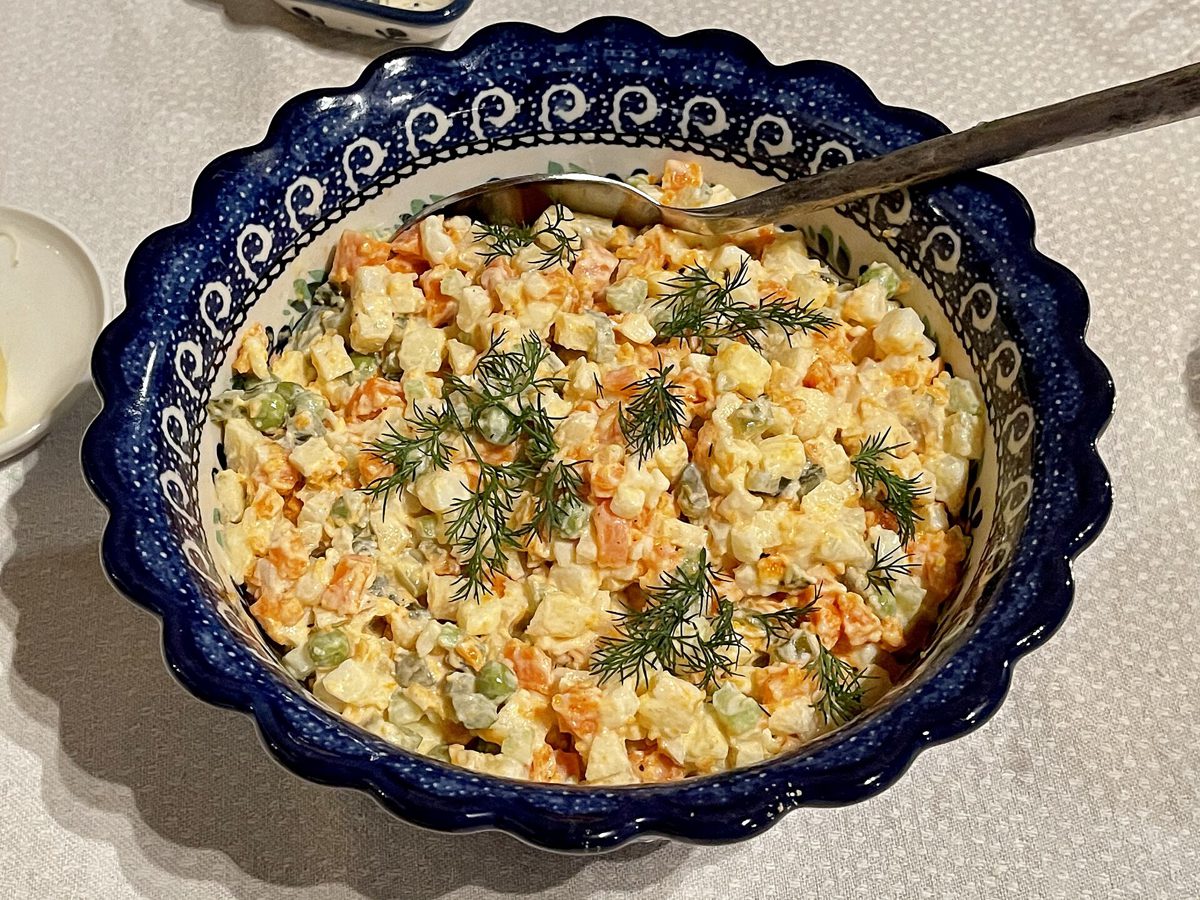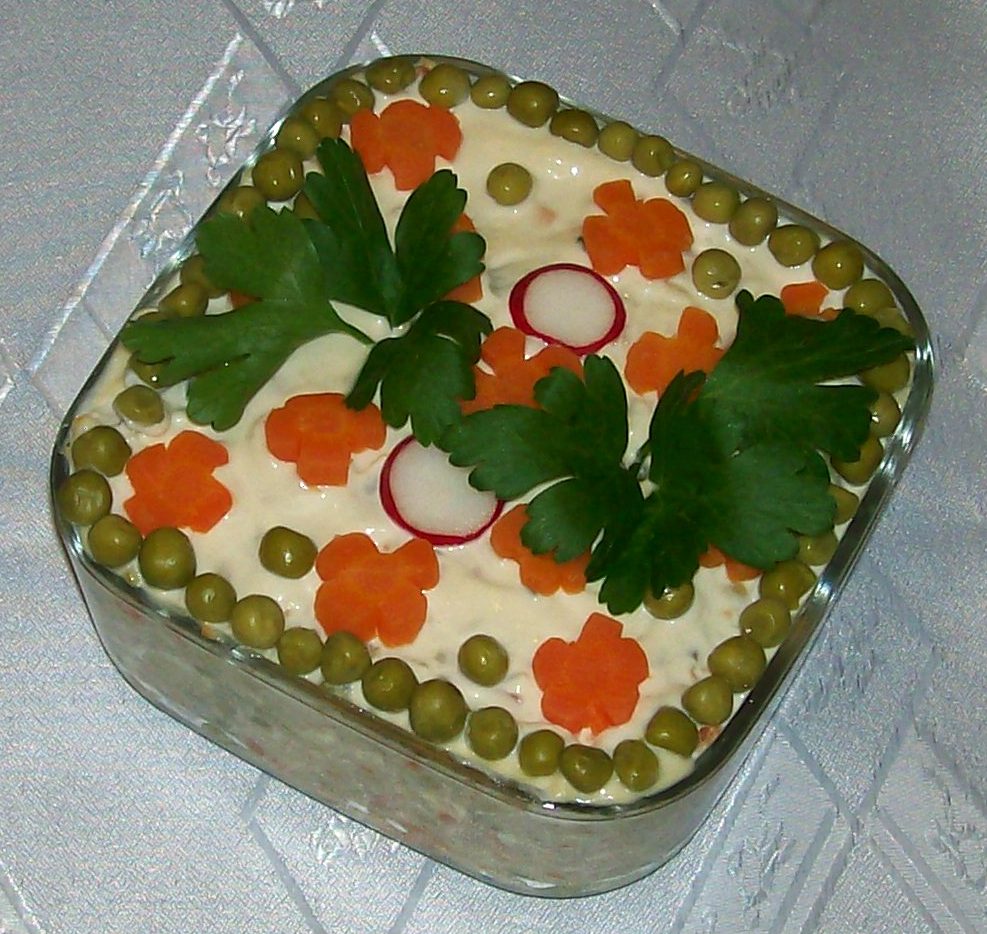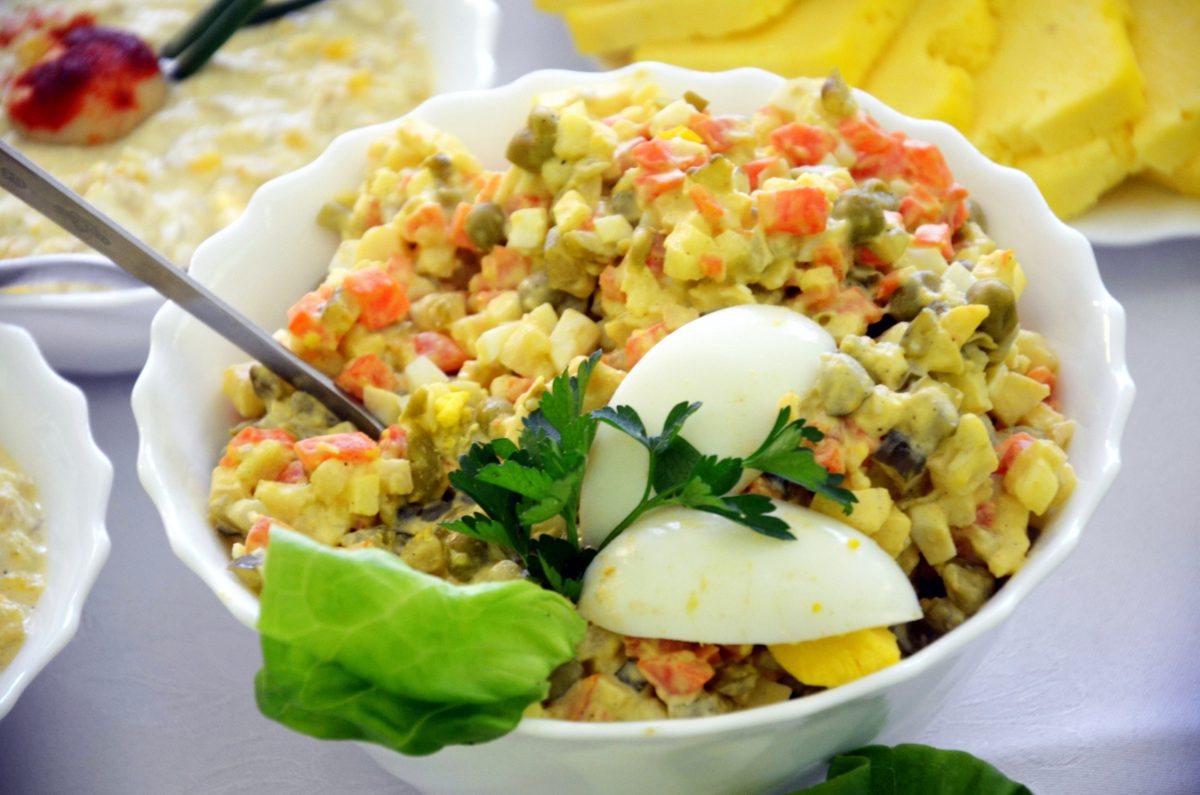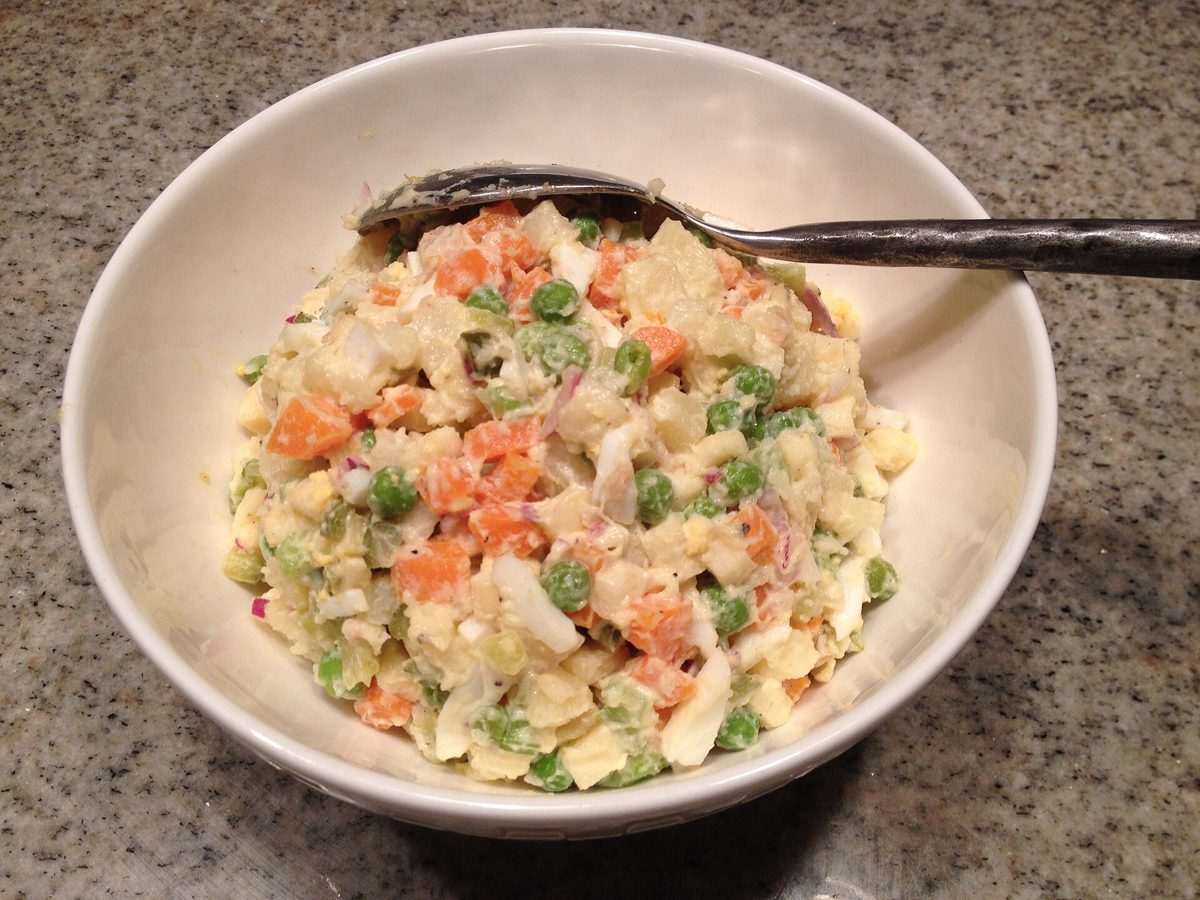
The story behind the recipe
Vegetable salad is not exclusively a Polish idea, and sources provide two stories of its origin. According to the first, its ancestor is a salad created in the 1860s by Lucien Olivier, a French-Belgian chef from the Moscow restaurant Hermitage. As Culture.pl writes, it contained capers, caviar, gherkins, smoked duck, veal tongue, and Provençal sauce, and Olivier took his secret to the grave in 1883. The oldest printed recipe appeared in Russia in 1894, and in the most famous old version, it included half a hazel grouse, a large gherkin, two potatoes, 3–4 lettuce leaves, 3 crayfish tails, a teaspoon of capers, 3–5 olives, meat jelly, and one and a half tablespoons of Provençal sauce or mayonnaise. After the revolutions of 1905 and 1917, Russian aristocrats who had to leave popularized it in Western Europe. In the Soviet version, the grouse was replaced with sausage, crayfish with carrot, and capers with canned peas; the only remnant of the old recipe was actually the mayonnaise.
The second story leads to France. The word "macédoine," meaning a salad of various diced vegetables, appears in French cookbooks in the 18th century, around the same time that mayonnaise first appeared in print. Polish Wikipedia presents both theories, and which is closer to the truth is uncertain. The salad came to Poland in an eastern, modified form, and carrots, celery, kohlrabi, turnips, and green peas were added. After 1945, its ingredients were mainly limited to root vegetables, and in the 1970s and 1980s, it became widely popular in Polish catering establishments. In the People's Republic of Poland, vegetables for it were often taken from broth. When it first appeared in a Polish cookbook is not known.
In Poland, it is eaten all year round, but most often at Christmas and Easter, as an addition to cold cuts and meats. Culture.pl states that it is hard to imagine a Polish Easter table without it, and in the People's Republic of Poland, it was also served on New Year's Eve alongside tartare, stuffed pike, cold legs, and pork loin with plums. In Poland, it is most often made without meat, and Olivier salad differs from it mainly by the addition of ham or sausage. A relative is the Silesian szałot, which Culture.pl describes as something intermediate between Russian salad and German potato salad; "Szałot śląski (herring salad)" has been on the Traditional Products List since 2006. In many homes, there is still a debate about whether to add potatoes, apple, egg, and corn to the vegetable salad.
Ingredients
Vegetables
-
250 g waxy potatoes (2 medium)
Abroad: waxy potatoes; Germany: festkochend - 250 g carrots (2–3 pieces)
-
120 g parsley root (1 large)
Abroad: parsley root or Hamburg parsley; Germany: Petersilienwurzel; according to Polonist, parsnip -
80 g celery root
Abroad: USA: celery root; UK and Australia: celeriac; Germany: Knollensellerie; or parsnip, turnip, or a stalk of celery
Additions
- 3 pcs eggs (hard-boiled)
-
150 g pickled cucumbers (about 3 medium)
Abroad: pickled without vinegar, from Polish or Jewish delis -
200 g canned peas (weight after draining, about half a 400 g can)
Abroad: USA: canned sweet peas; UK: garden peas; Germany: Erbsen sehr fein - 120 g sour apple (1 small, firm, such as gray renet or antonovka)
- 30 g onion (a quarter of a medium, not necessarily)
Sauce
-
150 g mayonnaise (about 6 tablespoons; or 100 g mayonnaise and 50 g thick natural yogurt)
Abroad: Kielecki mayonnaise in Polish stores; USA and Canada: Hellmann's or Best Foods Real Mayonnaise; UK: Hellmann's Real; Germany: Thomy Delikatess-Mayonnaise, not Salatcreme -
1 tsp (5 ml) mustard (sarepska or Dijon)
Abroad: mild or yellow mustard - ½ tsp (about 3 g) salt
- ¼ tsp (1.3 ml) ground black pepper
Method, step by step
-
Wash the potatoes, carrots, parsley, and celery well, but do not peel them. Cook them whole, in their skins, in salted water covered, for 20–40 minutes. The skin retains the flavor inside, and the vegetables do not fall apart. Check each with a knife and remove when soft but still firm: parsley and celery may be ready before thick carrots.
-
Place the eggs in cold water, bring to a boil, and cook for 9–10 minutes, then transfer them to cold water.
-
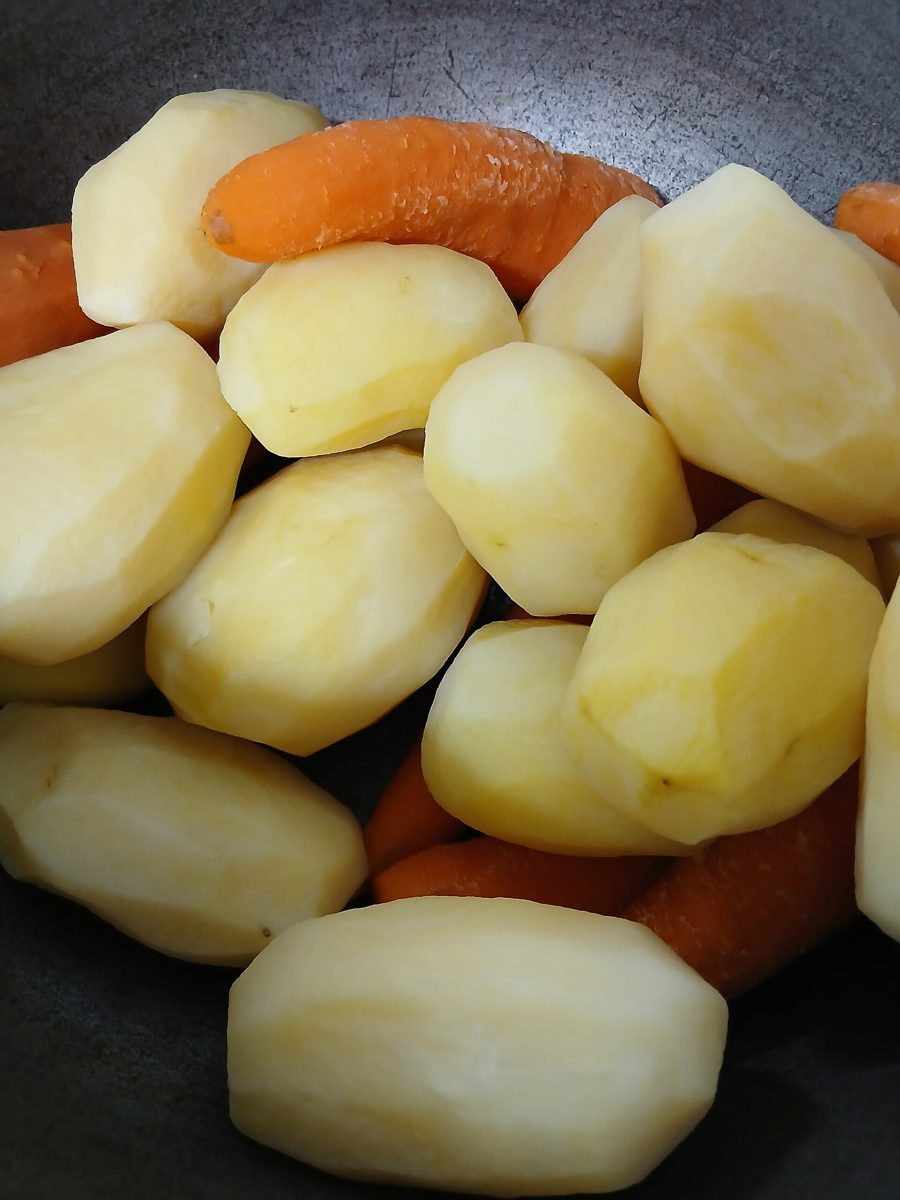
Completely cool the vegetables, and only then peel them, as the skin comes off easily after cooling. Cold vegetables are easier to cut evenly.
-
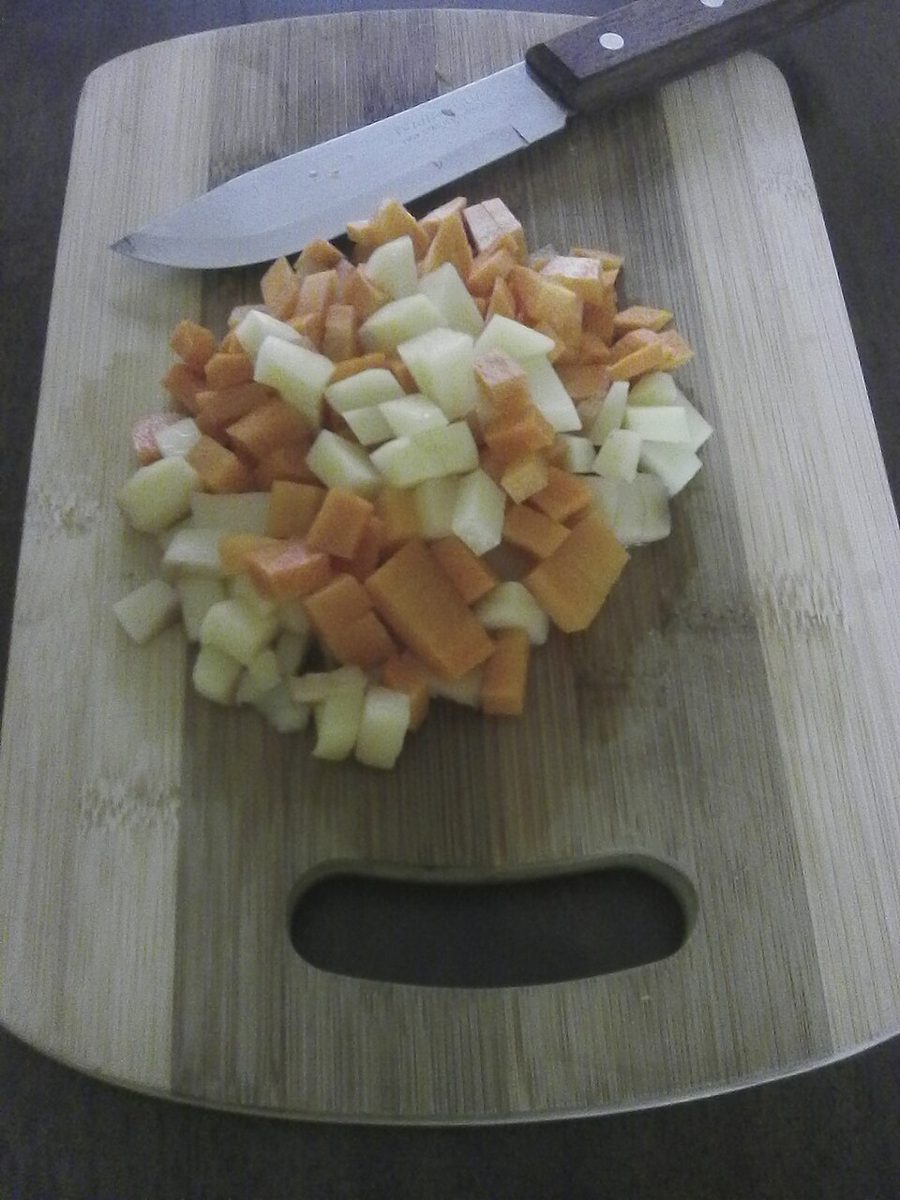
Dice the potatoes, carrots, parsley, and celery into small cubes, all the same size, preferably the size of a pea.
-
Peel the cucumbers if they have tough skin, dice them into the same size, and press or drain them in a colander. Drain and dry the peas well. Finely chop the onion, place it in a colander, and pour boiling water over it to lose its sharpness.
-
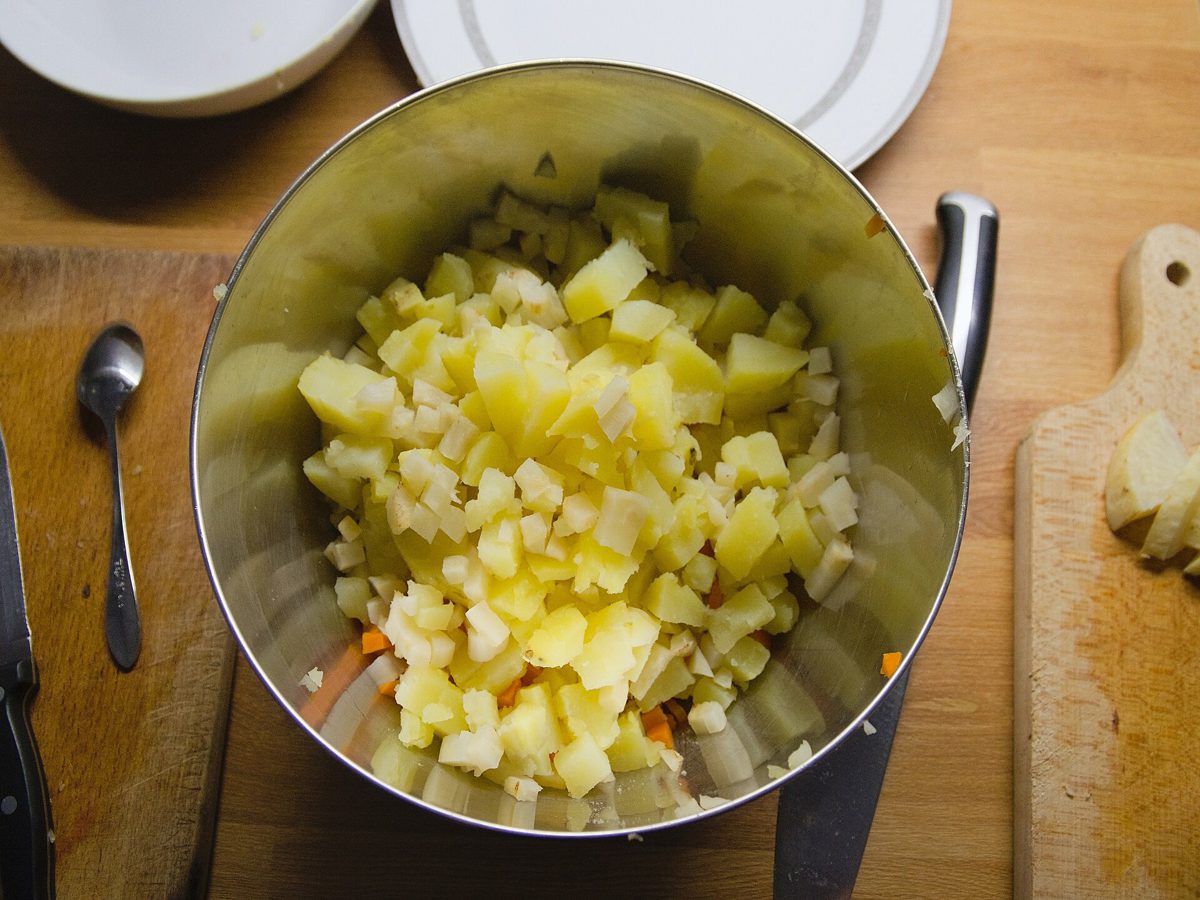
Transfer the diced vegetables to a large bowl.
-
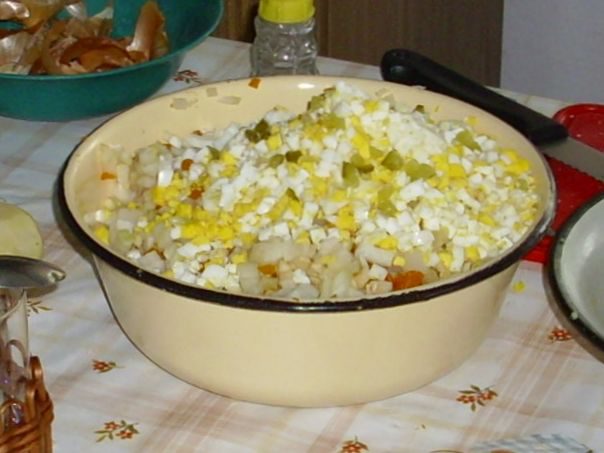
Peel the eggs and dice them. Add the eggs, cucumbers, peas, and onion to the bowl. Peel the apple, dice it, and add it last.
-
Mix the mayonnaise with mustard, salt, and pepper. First, add half and gently mix so that the vegetables do not turn into mush, then gradually add more until the vegetables are coated with the dressing but not swimming in it.
-
Cover the bowl and place the salad in the fridge for at least 2 hours to let the flavors meld. Before serving, taste and adjust seasoning with salt, pepper, or mustard.
Photos