
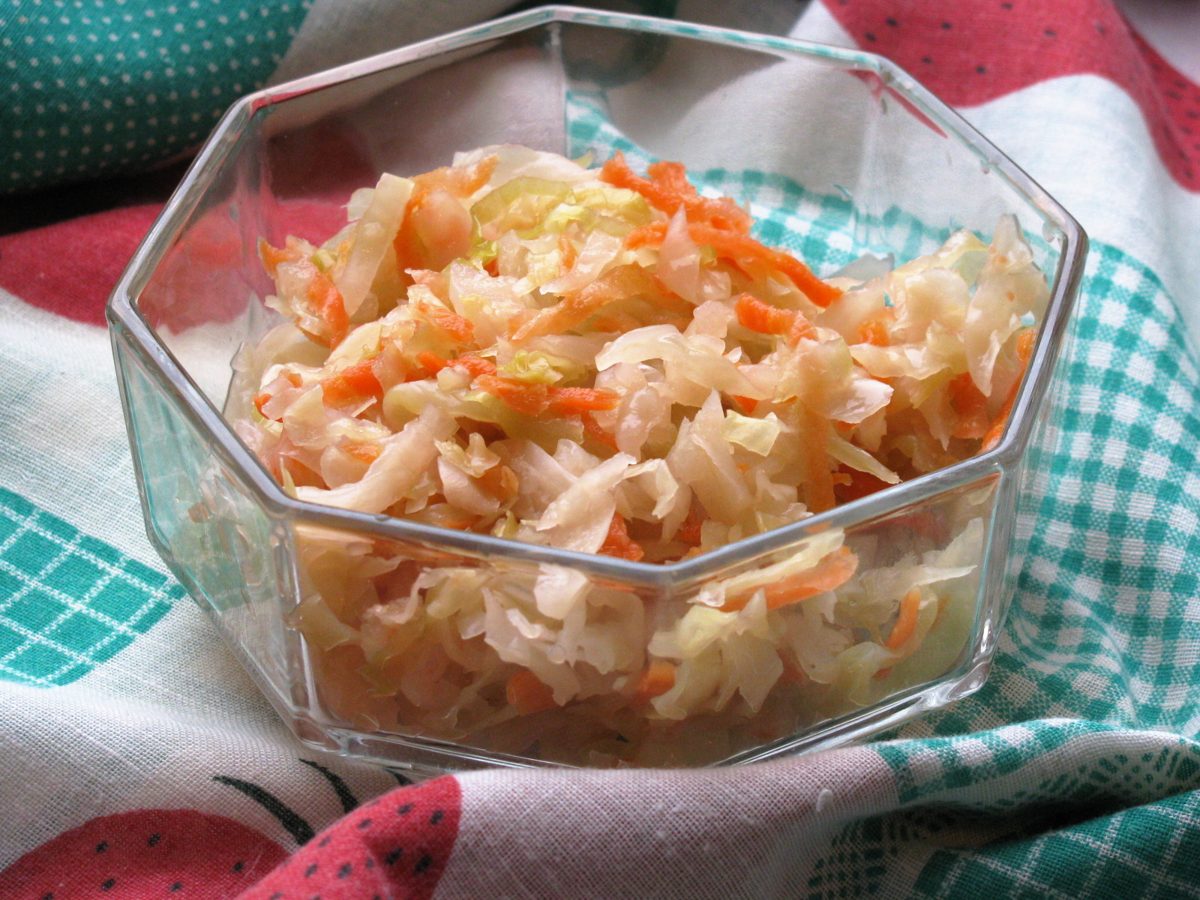
The story behind the recipe
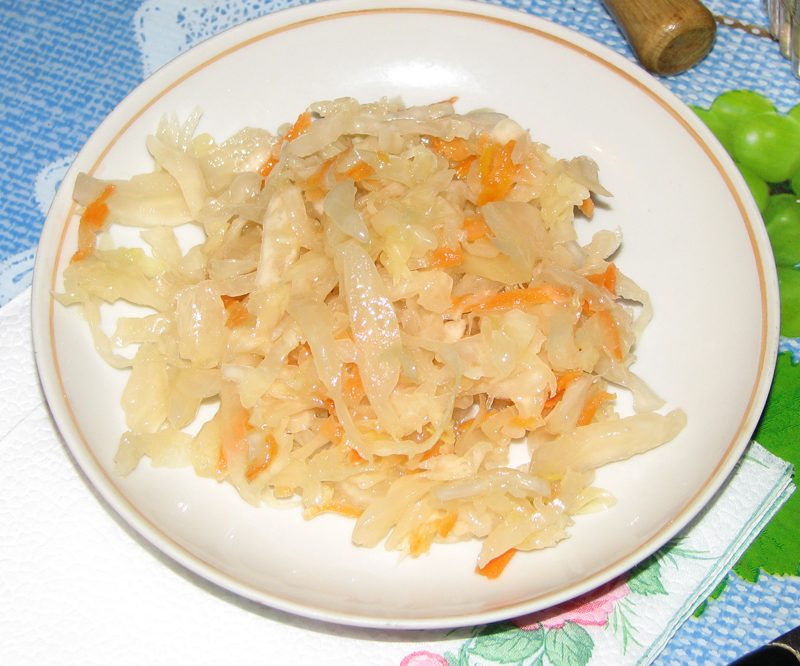
Sauerkraut and fermented cabbage are two names for the same thing: shredded cabbage fermented by lactic acid bacteria with just salt. Cabbage fermented with vinegar is pickled, not fermented. On the ministerial List of Traditional Products, there are, among others, "Sauerkraut from Bobrowy" from Opole, registered in 2007, and Lower Silesian "Fermented Cabbage from Ślęża", registered in 2008. The description of the latter reminds us that home gardens were called "cabbage patches" in the countryside, and in Z. Szromek-Rysowa's work "Food of the Rural Population in Silesia" from 1978, it is noted that sauerkraut was one of the staple dishes of peasants and was referred to as "oak cabbage".
Fermentation used to be a communal activity. According to the description of cabbage from Bobrowy, the cabbage had to be fermented by the end of October, as it could spoil after All Saints' Day. Men and women gathered in one house, chopped the heads with a large cleaver on boards, shared stories, and sang. The cabbage was pressed in a barrel with a wooden pestle or stomped on: usually, a man did this, while a woman had to wear a folk costume and a headscarf, and often children stomped after soaking their feet in water.
Lucyna Ćwierczakiewiczowa in the 1885 edition advised using only white heads, as green cabbage turns gray, and to ferment in a scalded oak barrel, preferably one that had previously held wine. Each layer was salted with a handful of salt and tightly packed by hand, and when the cabbage began to ferment, it was pierced with a long wooden stick "to let out the bitterness." After eight to ten days, the barrel was taken to the cellar. According to the description of cabbage from Bobrowy, the recipe has changed little since then.
Ingredients
Vegetables and salt (fermentation crock approx. 10 l or several large jars)
-
5 kg white cabbage (weight after peeling and removing cores, heavy, compact, white heads)
Abroad: USA and Canada: green cabbage; UK: white cabbage; Germany: Weißkohl - 500 g carrot (grated on a coarse grater)
-
110 g non-iodized salt (2% of the weight of cabbage with carrot, i.e., 20 g per kilogram)
Abroad: USA: canning and pickling salt; elsewhere, salt without iodine and anti-caking agents -
5 tsp (about 15 g) caraway seeds (can be omitted)
Abroad: caraway seeds; Germany: Kümmel
Optional additions
- 2 pcs apples (whole, unwaxed, placed in the center of the cabbage)
-
5 handfuls cranberries (fresh or frozen)
Abroad: cranberries - 2 pcs bay leaf
-
6 pcs allspice
Abroad: allspice
For covering and brine
- whole cabbage leaves (2–3 clean, from the outer leaves removed)
- 1 l boiled water (only if there is not enough juice, with 20 g of salt, cooled)
Method, step by step
-
Prepare the container: a fermentation crock or large jars with a total capacity of about 10 l. Wash them with hot water and detergent, scald with boiling water along with a plate, weights, and a wooden pestle. The cabbage should take up no more than about 90% of the crock and 80% of the jar, as it expands during fermentation.
-
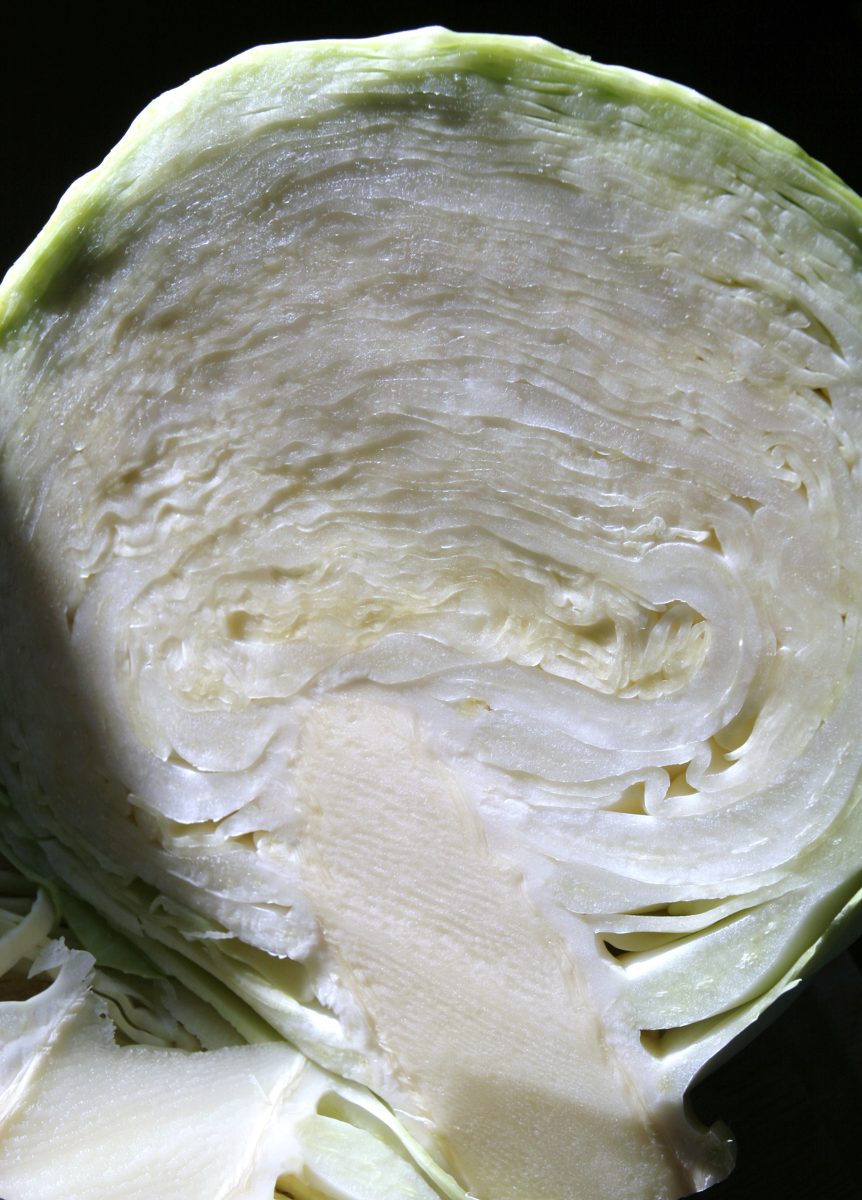
Remove 4 outer leaves from the heads and discard them, then set aside the next 2–3 nice leaves for covering. Wash the heads, cut them into quarters, remove the cores, and shred the cabbage as thinly as possible, into strips about 1.5 mm (1/16 inch) thick. Weigh it after shredding.
-
Peel the carrot and grate it on a coarse grater. Weigh the cabbage with the carrot and measure the salt: 20 g for each kilogram. Divide the salt, cabbage, and carrot into 4–5 equal portions so that each layer is salted evenly.
-
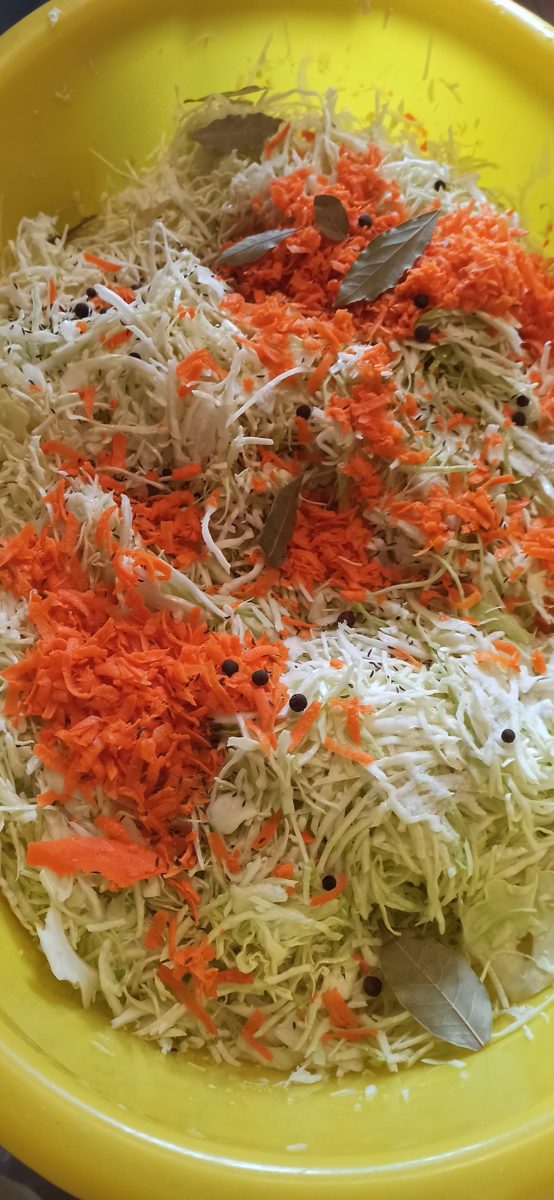
In a large bowl, mix a portion of cabbage with the carrot, salt, and caraway seeds, and if you like, also with cranberries, bay leaf, and allspice. Set aside for 30–60 minutes to allow the cabbage to soften and start releasing juice.
-
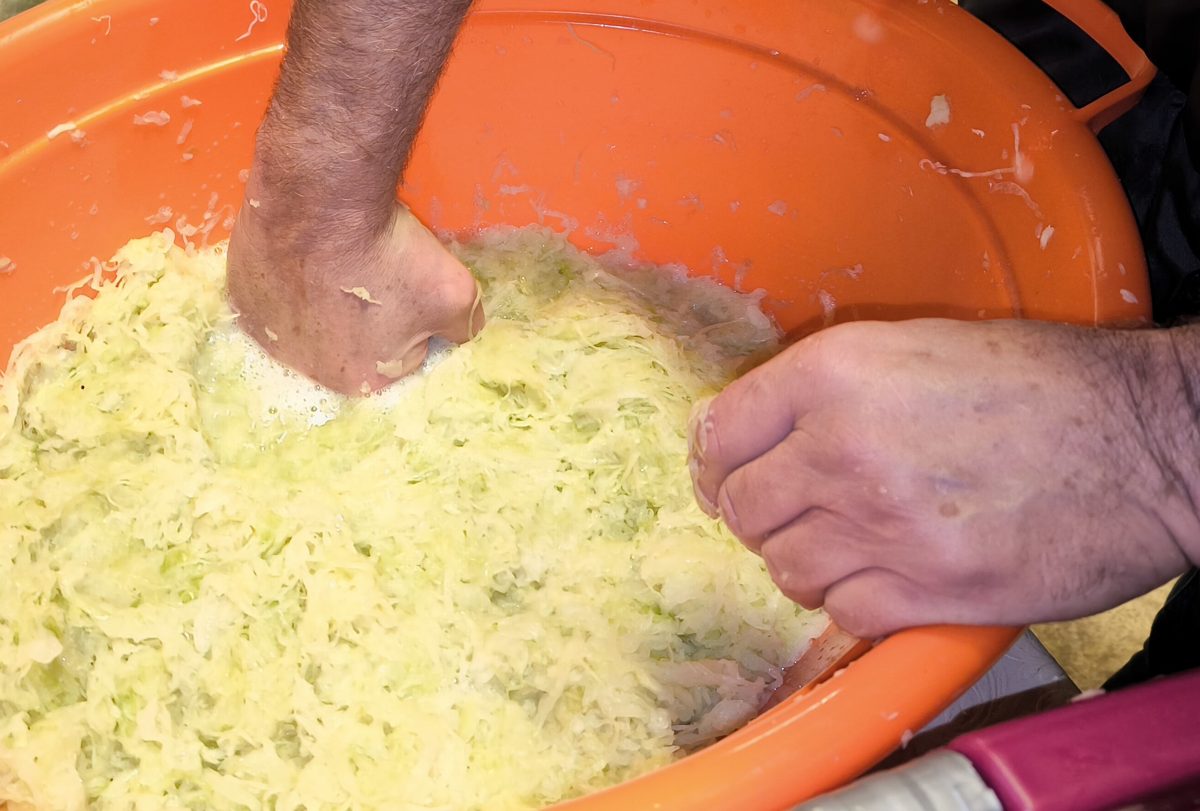
Knead the cabbage with your hands or fists for a few minutes until it becomes moist and juice collects at the bottom of the bowl. Do not overdo it, as cabbage that is kneaded too long will not be crunchy.
-
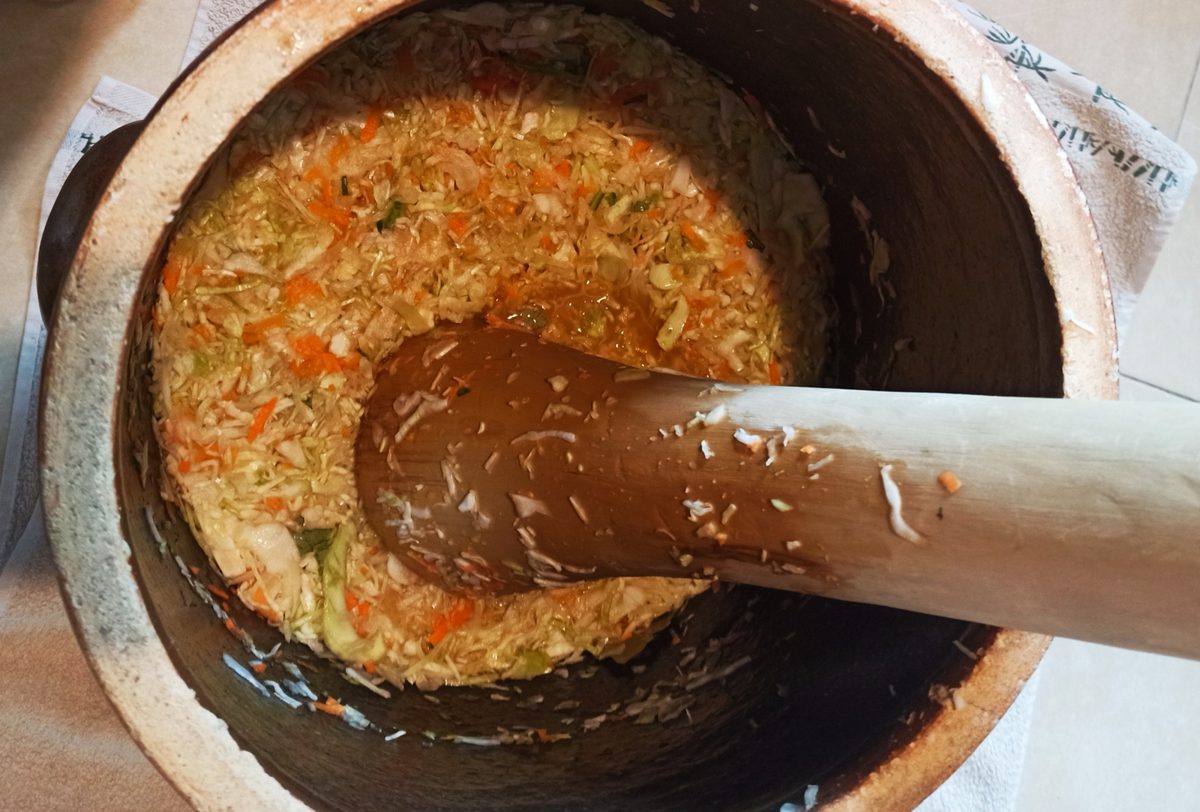
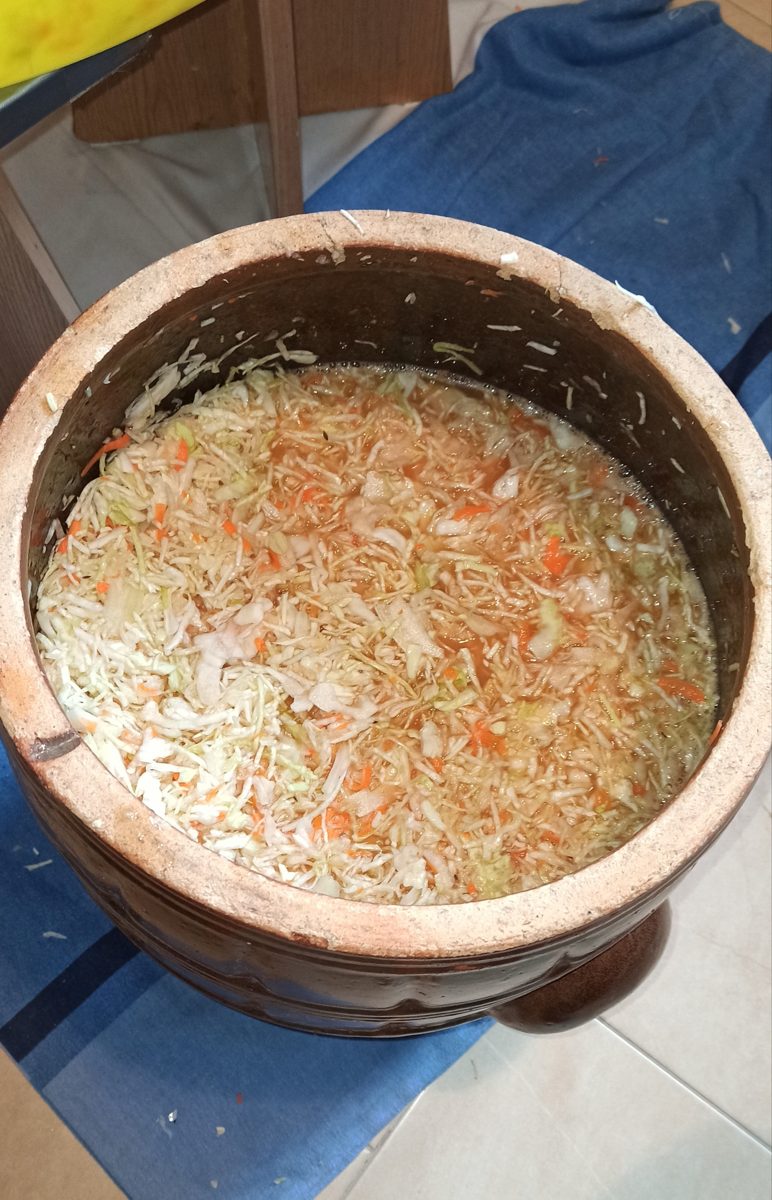
Transfer a portion to the crock and press it down with a wooden pestle until juice appears above the cabbage and there are no empty spaces. Only then add the next portion and press it down the same way. If you have a larger amount, place whole apples in the center of the cabbage.
-
Finally, press the cabbage down so that the juice covers it by 2.5–5 cm (1–2 inches). If there is not enough juice, add cooled brine made from 1 l of boiled water and 20 g of salt. Cover the cabbage with whole leaves, place a plate slightly smaller than the opening on top, and weigh it down with a jar filled with water or a sealed food bag with brine. Cover the container with a clean cloth. For jars, only screw the lids on loosely.
-
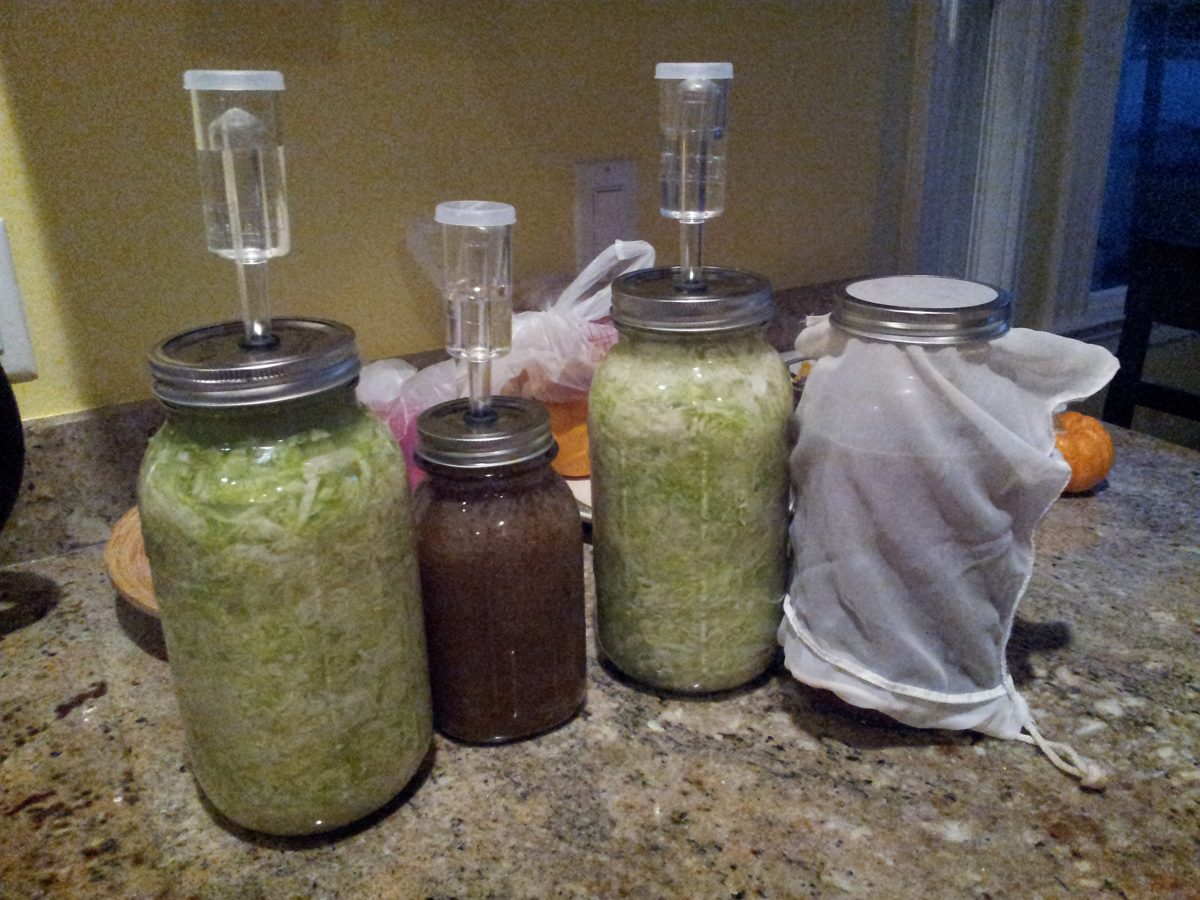
Place the cabbage at room temperature, ideally around 20–22°C (68–72°F). After 2–3 days, when it starts to bubble, pierce it with a clean wooden stick to the bottom in several places to release gases, and press it down again under the juice. For jars, unscrew the bulging lids, press the cabbage down, and screw them back on.
-
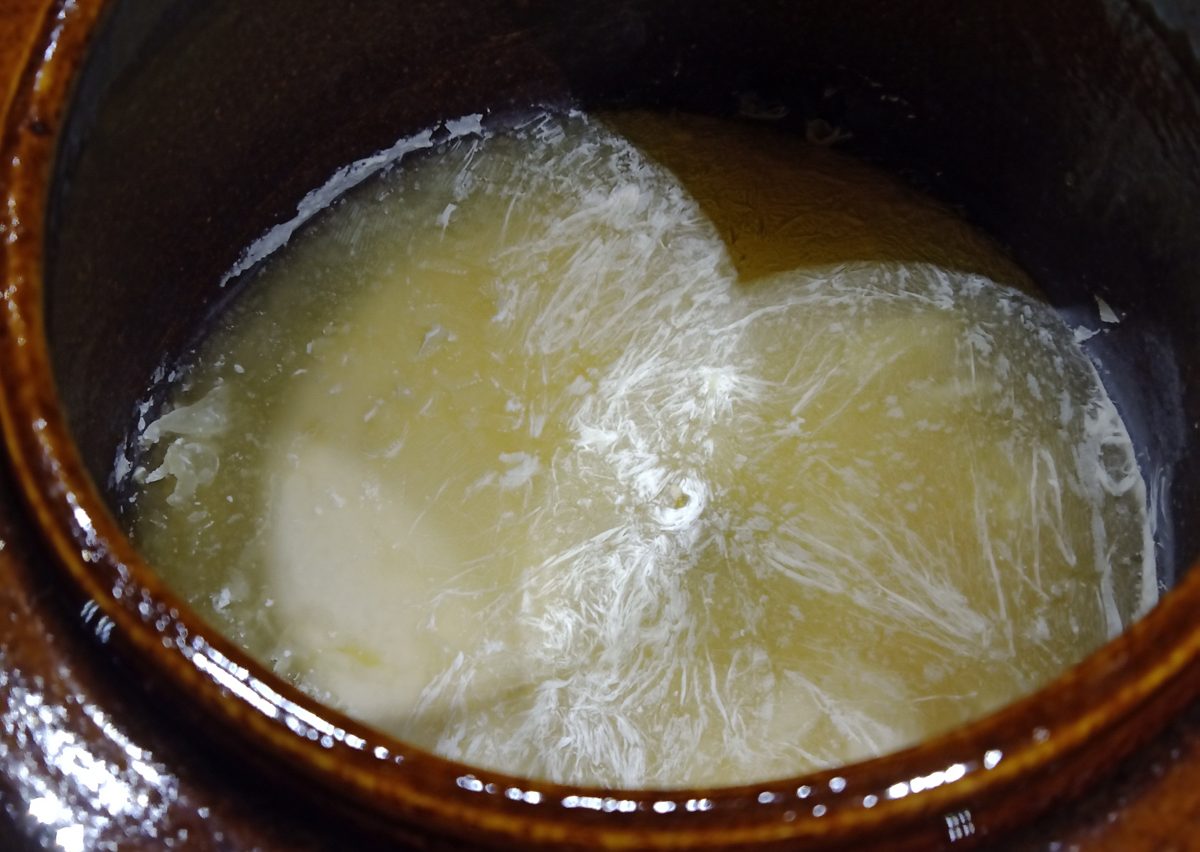
Check the cabbage 2–3 times a week. If a white scum forms on the brine, collect it with a clean spoon and check if the cabbage is still submerged in juice. If mold is visible on the cabbage, if it is slimy, or if it smells bad, do not taste it.
-
After 7–14 days, taste the cabbage with a clean fork. When it is sour enough, transfer it to scalded jars, pack it tightly, cover with juice so that it is submerged, and place it in the refrigerator. Fermented longer at 21–23°C (70–75°F), according to USDA, it fully matures after 3–4 weeks.
Photos
Comments (0)
No comments yet. Be the first!